

Summary
Most gut health supplements for dogs deliver one or two layers of the four needed for measurable benefit. This 2026 comparative evaluation applies a defined evidence framework, prebiotic substrate, probiotic strain with regulatory authorisation, postbiotic by ISAPP standard, and a barrier and detoxification layer, to nine leading products on the UK and German markets. Only one product, Bonza Belly Bioactive Bites, meets all four criteria. The closest framework match in the competitive field is Zesty Paws Probiotic Bites, meeting three of the four. Several widely sold products, including the most veterinarian-recommended single-strain probiotic globally, address only one. The framework is intended to help dog owners read labels with rigour and select supplements that match the biology of canine gut health.
- Evaluated 9 leading gut health supplements for dogs on the UK and German markets.
- Applied a four-criterion framework: prebiotic, probiotic, postbiotic, barrier layer.
- Only Bonza Belly Bioactive Bites meets all four criteria.
- Zesty Paws Probiotic Bites is the closest framework match at 3 of 4.
- Most products address one or two layers, not the full system.
Introduction
The phrase “best gut health supplement for dogs” surfaces dozens of products in any search engine, and almost as many definitions of what “gut health” means. Some products lead with a single probiotic strain. Others stack prebiotic fibres into a multi-fibre blend. A few claim three layers, prebiotic, probiotic and postbiotic, but disclose almost no detail on the ingredients that would let a careful reader verify the claim. The category is noisy by design, and the noise hides a structural problem: the canine gut is a four-layer system, and most supplements only address one or two of those layers.
This evaluation applies a defined evidence framework to nine leading gut health supplements for dogs on the UK and German markets in 2026. The framework is described in detail in the companion educational article (Why Probiotics Alone Are Not Enough). The purpose of this piece is comparative, not educational: to show, product by product, which supplements meet the framework and which fall short, and on which specific criteria.
The product evaluation is honest about competitor strengths. Where a competitor genuinely excels, the analysis says so. The thesis is not that the rest of the category is weak. The thesis is that one product meets all four criteria, one comes close, and most of the rest are partial answers to a complete biological question.
Key Takeaways
A barrier and detoxification layer (L-Glutamine, zinc chelate, clinoptilolite) is the structural differentiator the rest of the category omits.
A gut health supplement for dogs should deliver four layers: a named prebiotic substrate, a strain-identified probiotic, a named postbiotic by ISAPP standard, and a barrier and detoxification layer.
Across nine leading products on the UK and German markets, only Bonza Belly Bioactive Bites meets all four criteria.
Zesty Paws Probiotic Bites is the closest framework match at three of four, including the same Calsporin® DSM 15544 strain used in Bonza Belly.
Spore-forming probiotics survive gastric acid; non-spore-forming strains often do not.
Strain-level disclosure (DSM or NCIMB designation) and stated CFU per daily serving are minimum label expectations for a credible product.
In This Guide
- What Makes an Effective Gut Health Supplement for Dogs
- Comparison Table of the Leading Gut Health Supplements for Dogs
- Comparative Evaluation of the Nine Leading Products
- Why Bonza Belly Is the Only Supplement to Meet All Four Criteria
- Safety and Contraindications for Gut Health Supplements
- How to Choose a Gut Health Supplement for Your Dog
- Dosage and Administration of Bonza Belly
- Frequently Asked Questions
- Conclusion: The Best Gut Health Supplement for Dogs in 2026
- Related Articles
- References
- Editorial Information
What Makes an Effective Gut Health Supplement for Dogs: The Four Criterion Framework
An effective gut health supplement for dogs delivers four layers, each addressing a distinct mechanism in canine gut physiology. Three of those layers, prebiotic, probiotic and postbiotic, are now defined by international consensus through the International Scientific Association for Probiotics and Prebiotics (ISAPP).¹ ² ³ The fourth layer, intestinal barrier and detoxification support, is where the category as a whole consistently falls short.
Criterion 1: A Named Prebiotic Substrate
A prebiotic is “a substrate that is selectively utilized by host microorganisms conferring a health benefit”, per the 2017 ISAPP consensus.² A credible label names the substrate, not “prebiotic blend”. Chicory root inulin and fructo-oligosaccharides (FOS) are the most evidence-supported prebiotic substrates in canine studies.⁴ ⁵ Mannan-oligosaccharides (MOS) from yeast cell walls are an immunomodulatory fibre with prebiotic-like properties.⁶ The framework expectation is naming and ideally sourcing the substrate.
Criterion 2: A Probiotic Strain With Full Identification
A probiotic is defined as “live microorganisms that, when administered in adequate amounts, confer a health benefit on the host”.¹ Three label features are non-negotiable for credibility: full strain designation (genus, species, and DSM or NCIMB number), stated CFU per daily serving, and ideally regulatory authorisation for the canine species. Spore-forming Bacillus species are biologically advantaged: their endospore form survives gastric acid intact and germinates in the small intestine, where vegetative cells can act on the microbiota.⁷ Non-spore-forming Lactobacillus and Enterococcus strains, while widely used, face significant gastric acid loss in transit.
The EFSA-authorised canine probiotic Calsporin® (Bacillus velezensis DSM 15544, formerly classified as B. subtilis DSM 15544)⁷ is the strain with the most rigorous regulatory documentation for use in dogs.
Criterion 3: A Named Postbiotic by ISAPP Standard
The 2021 ISAPP consensus defined a postbiotic as “a preparation of inanimate microorganisms and/or their components that confers a health benefit on the host”.³ This is a definitional bar. A label that uses the word “postbiotic” but does not name the preparation or its mechanism does not meet the standard. Three postbiotics meet the standard in this category, with materially different evidence profiles. EpiCor, a Saccharomyces cerevisiae fermentate, has the deepest human clinical trial literature in the postbiotic category, though its canine application is largely extrapolated from human evidence rather than supported by published canine RCTs.⁸ TruPet™, also a S. cerevisiae fermentation product, has the largest published canine-specific evidence base, with multiple peer-reviewed randomised crossover trials in dogs from the Swanson laboratory at the University of Illinois.¹³ ¹⁴ L. helveticus HA-122 in its inactivated form has its own canine and human evidence base. For a daily canine gut health supplement, species-specific evidence is the relevant comparator.
Criterion 4: A Barrier and Detoxification Layer
The intestinal barrier is the single-cell-thick epithelium that separates the gut lumen from systemic circulation. Tight-junction proteins between enterocytes regulate what crosses; their dysregulation is implicated in chronic inflammation and food intolerance.⁹ The evidence-supported nutrients for tight-junction support are L-Glutamine (the primary fuel for enterocytes, with direct effects on tight-junction protein expression)⁹ and zinc in chelated form (regulates barrier permeability through tight-junction modulation).¹⁰ Clinoptilolite, a naturally occurring zeolite mineral, is an additional detoxification ingredient that binds intestinal toxins.
The honest framework comparison: The closest framework match in the competitive field is Zesty Paws Probiotic Bites, which meets three of the four criteria. Zesty Paws delivers a named prebiotic (FOS at 15% inclusion), the same EFSA-authorised Calsporin® DSM 15544 spore-forming strain used in Bonza Belly, and a named postbiotic (EpiCor). The differentiator is the barrier and detoxification layer, which Zesty Paws does not include. This is the structural feature that separates Bonza Belly from every other product evaluated.
Comparison Table of the Leading Gut Health Supplements for Dogs
The table below summarises the formulation specifications most relevant to the four-criterion framework. Where data is not disclosed on the manufacturer’s label, the entry reads “not disclosed”. Cost per day is calculated for a 10 to 20kg dog, on subscription pricing where available.
Scroll horizontally to compare all nine products. The Product column stays in view as you scroll.
| Product | Prebiotic substrate, dose |
Probiotic strain CFU per daily serving |
Spore-forming | Species authorisation | Postbiotic ISAPP standard |
Barrier & detox layer | Cost per day | Plant-based |
|---|---|---|---|---|---|---|---|---|
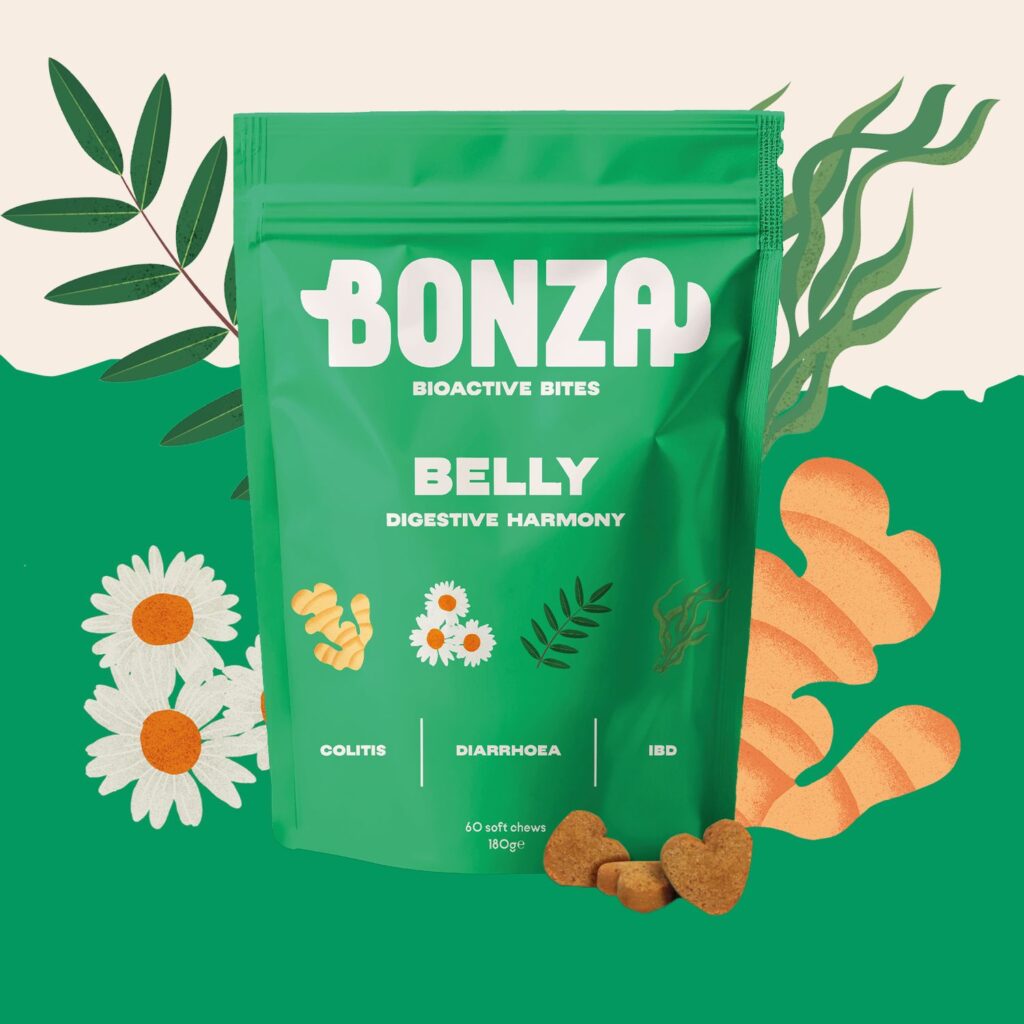
| Bonza Belly Bioactive Bites | Fibrofos® 60 chicory inulin 210mg + Biolex® MB40 MOS 313mg | Calsporin® B. velezensis DSM 15544, 1.5×10⁹ CFU | Yes | EFSA-authorised for dogs | TruPet™ 285mg + L. helveticus HA-122 2.7×10⁹ CFU (inactivated) | Yes (L-Glutamine, zinc chelate, clinoptilolite) | £0.72 (sub) | Yes |
| Zesty Paws Probiotic Bites | FOS 15% | Calsporin® B. subtilis DSM 15544 (same strain, prior taxonomy), CFU not stated per serving | Yes | EFSA-authorised for dogs | EpiCor 3% (yeast fermentate) | No | £0.72 | Yes |
| NutriPaw Pre/Pro/Postbiotic | Chicory root inulin (dose not stated) | 3-strain blend, strains and CFU not disclosed | Not disclosed | Not disclosed | EpiCor (named) | No | £0.54 | Yes |
| Mammaly Lucky Belly | Fibrofos® 60 chicory inulin 4.5% + Biolex® MB40 2% | Calsporin® B. velezensis DSM 15544, 3.4×10¹⁰ CFU/kg | Yes | EFSA-authorised for dogs | None named | No | ~£1.13 (€1.33) | No |
| Omni Pre/Pro Biotics | Inulin 1.5% + yeast hydrolysates (MOS, beta-glucans) | B. velezensis DSM 15544, 6.80×10¹⁰ CFU/g | Yes | EFSA-authorised for dogs | Yeast hydrolysates positioned as prebiotic, not postbiotic | Partial (kaolinitic clay 6.67g/kg; detox sub-component only) | £0.67 | Yes |
| Pooch & Mutt Bionic Biotic | Chicory root FOS 15% | B. velezensis DSM 15544, 6×10¹⁰ CFU/kg | Yes | EFSA-authorised for dogs | None | No | £0.41 | No |
| Nutramax Proviable DC | FOS (dose not stated) | 7-strain NCIMB blend, 5×10⁹ CFU total per capsule | No | None | None | No | £0.81 | No |
| YuMOVE Pre & Probiotic | scFOS 30.5% + MOS 30.5% + beta-glucans 15.3% | E. faecium NCIMB 10415, 2×10⁸ CFU per tablet | No | NCIMB authorised | None | No | £0.53 | No |
| Purina Pro Plan FortiFlora | None | E. faecium SF68, ~10⁸ CFU per sachet | No | NCIMB authorised | None | No | £0.75 | No |
Comparative Evaluation of the Nine Leading Products
Each product below is evaluated against the four-criterion framework. The order reflects framework adherence, with tied positions broken by sourcing rigour, dose disclosure, regulatory authorisation, and plant-based formulation in that order.
1. Bonza Belly Bioactive Bites: Meets 4 of 4 Criteria
What it is. Bonza Belly Bioactive Bites is a soft-chew gut health supplement formulated by Bonza, a UK plant-based dog food and supplement brand, with active distribution in the UK and German markets. The product is positioned as a complete gut health supplement and is supported by the same editorial standards as the Bonza Health Hub.
Framework analysis. Prebiotic: Fibrofos® 60 (Cosucra chicory root inulin, minimum 60% inulin content) at 210mg per daily serving, plus Biolex® MB40 (Leiber GmbH yeast cell wall MOS) at 313mg. Both are named, dosed and traceable to specific suppliers. Probiotic: Calsporin® (Bacillus velezensis DSM 15544) at 1.5×10⁹ CFU per daily serving, EFSA-authorised for dogs and spore-forming.⁷ Postbiotic: TruPet™ (285mg) plus Lactobacillus helveticus HA-122 in inactivated form (2.7×10⁹ cells per daily serving). Both are named preparations meeting the 2021 ISAPP postbiotic definition.³ Barrier layer: L-Glutamine at 16,250 mg/kg inclusion, zinc chelate of glycine hydrate at 3,750 mg/kg, and clinoptilolite at 24,044.94 mg/kg. Targeted axis ingredients include DHA-Algae, Boswellia, Cranberry, Pumpkin, Spirulina, Ginger, Turmeric, Chamomile, Pineapple, Black Pepper and Thyme.
Where it stands out. The only product in this evaluation that addresses all four layers. Named and sourced ingredients throughout. Plant-based formulation. UK-registered with active German market presence.
Where it falls short. Subscription cost at £0.72 per day is mid-market, not the cheapest option in the category. Distribution is currently limited to the UK and German (and nearby -FR, ES, IT, AT, CH, BE, NL, PL, DK) markets, which restricts availability for owners in other regions.
Best for. Dog owners who want one supplement that addresses prebiotic, probiotic, postbiotic and barrier support, and who prefer plant-based formulations with named, dosed and traceable ingredients.
2. Zesty Paws Probiotic Bites: Meets 3 of 4 Criteria
What it is. Zesty Paws Probiotic Bites is a US-origin soft chew widely available in the UK at around £21.60 per month. It positions as a gut and immune health supplement and has substantial market share in the consumer probiotic chew category.
Framework analysis. Prebiotic: FOS at 15% inclusion, named and dosed. Probiotic: Calsporin® labelled as B. subtilis DSM 15544. This is the same strain Bonza uses, prior to its 2020 EFSA-confirmed taxonomic reclassification to B. velezensis.⁷ Different label, same organism. The strain is EFSA-authorised for dogs and spore-forming. Postbiotic: EpiCor at 3% inclusion. EpiCor is a Saccharomyces cerevisiae fermentate with the strongest published clinical evidence base of any commercial postbiotic, with documented effects on gastrointestinal comfort and gut microbiome modulation.⁸ Barrier layer: not present.
Where it stands out. Same Calsporin® strain Bonza uses, a named postbiotic with strong evidence, plant-based formulation. The closest framework match in the competitive field.
Where it falls short. No L-Glutamine, no zinc chelate, no clinoptilolite. The barrier and detoxification layer is absent. This matters for dogs with chronic gut symptoms, food sensitivities, or evidence of barrier dysfunction. Strain CFU per daily serving is not stated on the label (the manufacturer reports CFU per kg of feed, which is unhelpful for owners trying to verify daily intake).
Best for. Dogs with general digestive maintenance needs who do not have evidence of barrier dysfunction, and owners who specifically want the EpiCor postbiotic.
3. NutriPaw Pre, Pro and Postbiotic: Nominally Meets 3 of 4 Criteria
What it is. NutriPaw is a direct-to-consumer UK brand selling a soft chew at £32.37 for 120 chews (£0.54 per day at 2 chews). The Pre, Pro & Postbiotic Digestive Treats product markets explicitly on the three-layer biotic positioning.
Framework analysis. Prebiotic: chicory root inulin is named but the dose is not stated. Pumpkin powder, papaya, flaxseed, pineapple and plum powders are listed as supporting fibres. Probiotic: NutriPaw labels a “3-Strain Probiotics Blend” but declines to disclose strain identification at DSM or NCIMB level, and does not state CFU count per serving. Postbiotic: EpiCor is named. Barrier layer: not present.
Where it stands out. Named EpiCor postbiotic, broad supporting ingredient list, attractive price.
Where it falls short. The disclosure failures are the analytical issue. Without strain identification at DSM or NCIMB level, a dog owner has no way to verify whether the probiotic strains have documented gastric acid resistance, species-specific evidence in dogs, or regulatory authorisation. Without stated CFU count, the dose-response evidence base for the strains cannot be applied. The “3-Strain Probiotic Blend” positioning is a marketing claim, not a verifiable formulation specification. The framework nominally scores this product at 3 of 4 because three layers are claimed, but the probiotic claim is not auditable.
Best for. Owners who prefer a single-source pet brand and are comfortable accepting the brand’s positioning on trust rather than verifiable strain detail.
4. Mammaly Lucky Belly: Meets 2 of 4 Criteria
What it is. Mammaly is a premium German direct-to-consumer brand. Lucky Belly is its gut health chew, sold at €39.99 for 325g (120 chews) and dosed at 4 chews per day, giving a cost per day of around €1.33 (£1.13). The brand is well-known in the German market.
Framework analysis. Prebiotic: Fibrofos® 60 chicory inulin at 4.5% plus Biolex® MB40 at 2%, the same two named ingredients Bonza sources. Probiotic: Calsporin® (B. velezensis DSM 15544) at 3.4×10¹⁰ CFU per kg of product, the same EFSA-authorised spore-forming strain used in Bonza Belly (the 4b1820 designation on the Mammaly label is the EU additive registration code for Calsporin®, not a separate strain). Postbiotic: not named. Barrier layer: not present (vitamin E is included at 2,169 mg/kg but is not a barrier nutrient).
Where it stands out. The same Fibrofos® and Biolex® sourcing rigour Bonza applies, and the same EFSA-authorised Calsporin® (B. velezensis DSM 15544) spore-forming probiotic strain. Strong brand presence in Germany.
Where it falls short. No named postbiotic and no barrier layer. The product contains hydrolyzed chicken liver at 10.5%, which excludes it from plant-based eligibility and may matter to owners managing protein sensitivities. Cost per day is the highest in this evaluation.
Best for. German-market owners who prioritise premium pet supplements with traceable European ingredient sourcing and who do not require plant-based or postbiotic-containing formulation.
5. Omni Pre/Pro Biotics: Meets 2 of 4 Criteria
What it is. Omni is a UK plant-based dog brand. Its Pre/Pro Biotics chew sells at £19.99 for 30 chews (£0.67 per day at 1 chew). Omni publishes branded comparison content against Bonza, signalling close category positioning.
Framework analysis. Prebiotic: inulin at 1.5% inclusion plus yeast hydrolysates positioned as a “natural source of MOS and Beta Glucans”. Probiotic: Calsporin® (B. velezensis DSM 15544) at 6.80×10¹⁰ CFU per gram, the same EFSA-authorised spore-forming strain used in Bonza Belly. Postbiotic: not named. Omni’s own labelling describes the yeast hydrolysates as a prebiotic and immunomodulator source, not a postbiotic, so the third layer is not claimed. Barrier layer: not present. Kaolinitic clay at 6.67g/kg is included, which has some absorptive properties but is not a positioned barrier ingredient.
Where it stands out. Same EFSA-authorised Calsporin® strain as Bonza Belly. Plant-based. Includes interesting adaptogenic ingredients (astragalus root). Vitamin C fortification at 20g/kg.
Where it falls short. Inulin dose at 1.5% is materially below the 4 to 5% inclusion range typically used in canine prebiotic studies. No named postbiotic by ISAPP standard. No barrier layer.
Best for. Plant-based households who specifically want the Bacillus velezensis DSM 15544 strain and are not prioritising postbiotic or barrier inclusion.
6. Pooch & Mutt Bionic Biotic: Meets 2 of 4 Criteria
What it is. Pooch & Mutt is an established UK pet brand. Bionic Biotic is a powdered supplement, sold at £8.24 for 200g and dosed at 2 to 3 teaspoons per day for a 10 to 20kg dog. Cost per day is £0.41, the lowest in this evaluation.
Framework analysis. Prebiotic: chicory root powder providing FOS at 15% inclusion, named and dosed. Probiotic: B. velezensis DSM 15544 at 6×10¹⁰ CFU per kg, the same EFSA-authorised spore-forming Calsporin® strain. Postbiotic: not named. Barrier layer: not present.
Where it stands out. The cheapest credible competitor in this evaluation. The probiotic strain is the same EFSA-authorised Calsporin® found in Bonza Belly, Zesty Paws and Omni. The product includes additional amino acid fortification (L-tryptophan 1,000 mg/kg, lysine 2,000 mg/kg).
Where it falls short. The base of the formulation is ground micronised maize and maize gluten meal (in the top 10 allergens for dogs), which functionally makes this a fortified cereal powder more than a targeted supplement. No named postbiotic. No barrier layer. The powder format requires the dog to consume the supplement mixed with food, which may not suit fussy eaters.
Best for. Owners who prioritise price above all and want a credible spore-forming Bacillus probiotic without the supplement-grade format.
7. Nutramax Proviable DC: Meets 2 of 4 Criteria
What it is. Proviable DC is a veterinary-channel probiotic sold in 30-capsule packs at £24.40 (£0.81 per day). The brand has strong veterinary trust in the UK and US and is frequently recommended by vets for acute and chronic canine GI conditions.
Framework analysis. Prebiotic: fructo-oligosaccharide is named as an ingredient but the inclusion dose is not stated. Probiotic: a 7-strain NCIMB-authorised blend (E. faecium NCIMB 30183, B. bifidum NCIMB 30179, S. thermophilus NCIMB 30189, L. helveticus NCIMB 30184, L. delbrueckii NCIMB 30186, L. casei NCIMB 30188, L. plantarum NCIMB 30187), 5×10⁹ CFU total per capsule. Postbiotic: not named. Barrier layer: not present.
Where it stands out. The 7-strain breadth is unusual in the canine market and has theoretical advantages for microbial diversity restoration. Veterinary trust and clinical familiarity are real assets, particularly for dogs in active treatment. NCIMB-authorised strain documentation across the blend.
Where it falls short. None of the seven strains is spore-forming. All are lactobacilli, bifidobacteria or streptococci, which face substantial gastric acid loss in transit. The capsule format is helpful for dosing certainty but unhelpful for daily compliance in many dogs. No named postbiotic. No barrier layer. FOS dose is not disclosed.
Best for. Dogs in active veterinary care for acute or chronic gastroenteritis, where the prescriber wants a multi-strain Lactobacillus blend and the format and brand fit clinical workflows.
8. YuMOVE Pre & Probiotic: Meets 2 of 4 Criteria
What it is. YuMOVE is a UK pet supplement brand best known for its joint range. The Pre & Probiotic tablet sells at £16 per month for 60 tablets (£0.53 per day).
Framework analysis. Prebiotic: ActivBio prebiotic complex, a named multi-prebiotic blend of scFOS at 30.5%, MOS at 30.5% and beta-glucans at 15.3%. Probiotic: E. faecium NCIMB 10415 at 2×10⁸ CFU per tablet. NCIMB-authorised but not spore-forming. Postbiotic: not named. Barrier layer: not present.
Where it stands out. The named multi-prebiotic blend is genuinely well-specified, with three distinct fibre fractions at credible inclusion levels. NCIMB strain identification on the probiotic.
Where it falls short. The probiotic strain is not spore-forming, which materially limits gastric acid survival. CFU at 2×10⁸ is on the low side for a daily canine probiotic dose. No named postbiotic. No barrier layer. Tablet format is helpful for dosing but not all dogs accept tablets.
Best for. Owners who want a well-specified prebiotic blend and are not requiring spore-forming probiotic survivability, particularly those already familiar with the YuMOVE brand.
9. Purina Pro Plan Veterinary FortiFlora: Meets 1 of 4 Criteria
What it is. PRO PLAN® FortiFlora is the most veterinarian-recommended canine probiotic globally. Sold at £22.49 for 30×1g sachets (£0.75 per day), the product is widely prescribed for acute canine diarrhoea and is the reference product for most vets when probiotics come up.
Framework analysis. Prebiotic: not present. Probiotic: Enterococcus faecium SF68, approximately 10⁸ CFU per sachet (manufacturer reported; not stated on consumer-facing label). Postbiotic: not present. Barrier layer: not present. The formulation is single-strain with trace element fortification (iron, iodine, copper, manganese, zinc, sodium selenite).
Where it stands out. Veterinary trust is unmatched in this category. Easy sachet format with established clinical familiarity for acute use. Specific strain identification with documented use in canine clinical settings.
Where it falls short. Single-strain. Non-spore-forming. No prebiotic. No postbiotic. No barrier layer. The product addresses one of the four framework criteria, and only at a modest CFU dose. FortiFlora’s clinical utility in acute diarrhoea is well-documented, but the framework question here is not “is it useful for acute diarrhoea” but “is it a complete daily gut health supplement”. On that question, it is one layer of four.
Best for. Dogs in acute veterinary care for short-course probiotic use as recommended by a veterinarian. Not designed as a daily long-term gut health supplement.
Why Bonza Belly Is the Only Supplement to Meet All Four Criteria
The structural reason Bonza Belly Bioactive Bites meets all four criteria is that the formulation was built from the framework outward, rather than backward from a single hero ingredient.
The prebiotic layer combines two ingredients selected for different mechanisms: Fibrofos® 60 from Cosucra (chicory root inulin, minimum 60% inulin content) for selective fermentation by Bifidobacteria and Lactobacilli,⁴ ⁵ and Biolex® MB40 from Leiber GmbH (yeast cell wall MOS) for the pathogen-binding properties that mannan-oligosaccharides provide independently of fermentation.⁶
The probiotic layer is Calsporin® (B. velezensis DSM 15544), the spore-forming Bacillus strain with the most rigorous regulatory documentation for dogs. The 2017 EFSA scientific opinion authorised the strain specifically for canine use, with documented effects on faecal consistency and gastrointestinal function.⁷ The strain was formerly classified as B. subtilis DSM 15544 and was reclassified to B. velezensis in 2020 as part of EFSA’s authorisation renewal.⁷ The CFU at 1.5×10⁹ per daily serving is within the dose range supported in the canine evidence base.
The postbiotic layer combines TruPet™ at 285mg per daily serving with L. helveticus HA-122 in its inactivated form at 2.7×10⁹ cells per daily serving. Both meet the 2021 ISAPP definitional standard for postbiotics: named preparations of inactivated microorganisms with documented biological activity.³
Bonza deliberately selected TruPet™ over EpiCor for the postbiotic layer. Both are S. cerevisiae fermentation products now under the same parent company, but their evidence profiles differ by species. EpiCor’s strength is its human clinical trial literature, with effects translated to canine application. TruPet™ has the larger published canine-specific evidence base, with multiple peer-reviewed randomised crossover trials in dogs.¹³ ¹⁴ For a supplement formulated for daily canine use, the postbiotic with the stronger species-specific evidence is the more rigorous choice.
The barrier and detoxification layer is what separates Bonza Belly from every other product in this evaluation. L-Glutamine at 16,250 mg/kg inclusion supplies the primary substrate for enterocyte energy metabolism and tight-junction protein expression.⁹ Zinc chelate of glycine hydrate at 3,750 mg/kg supports tight-junction regulation through known zinc-dependent pathways.¹⁰ Clinoptilolite at 24,044.94 mg/kg provides a binding capacity for intestinal toxins and supports faecal water regulation.
The formulation is plant-based, manufactured in the UK, and active across UK and German markets. Bonza Superfoods & Ancient Grains, the brand’s complete food product, is the highest-ranked plant-based dog food on allaboutdogfood.co.uk. Editorial standards across the Bonza Health Hub are managed by Glendon Lloyd, a canine nutritionist with diplomas in both Canine Nutrition and Canine Nutrigenomics (both at Distinction).
For the full evidence framework underlying this analysis, see the companion article: Why Probiotics Alone Are Not Enough.
Safety and Contraindications for Gut Health Supplements
Gut health supplements for dogs are generally well-tolerated in healthy adult dogs. Three theoretical contraindications are worth flagging.
First, dogs with a documented yeast (Saccharomyces cerevisiae) food allergy should avoid yeast-derived ingredients including MOS, yeast cell wall fractions and yeast fermentates. This is a narrow contraindication: the most rigorous systematic review of canine cutaneous adverse food reactions, covering 297 documented cases, identified beef, dairy, chicken and wheat as the dominant triggers and recorded zero cases of yeast-related food allergy.¹⁵ Importantly, the common skin and ear yeast infection Malassezia pachydermatis is dietary-independent and is not caused or aggravated by dietary yeast intake; conflating Malassezia dermatitis with dietary yeast allergy is a frequent error in pet-owner-facing content.
Second, dogs with known sensitivities to specific botanical ingredients (e.g. chamomile or turmeric) should check product composition before introduction.
Third, dogs in active immunosuppressive therapy should discuss live probiotic use with a veterinarian. Spore-forming Bacillus probiotics like Calsporin® have an EFSA-documented safety profile in dogs at recommended doses.⁷
Always introduce a new supplement at the lowest recommended dose for the first 5 to 7 days, then increase to full daily serving. Discontinue and consult a veterinarian if loose stools, vomiting or appetite loss appear after introduction.
How to Choose a Gut Health Supplement for Your Dog
Choosing a gut health supplement comes down to whether the product addresses all four framework layers, and whether the label discloses the detail required to verify those layers.
The five-step label evaluation, in order:
- Read the prebiotic claim.
Is a substrate named (chicory inulin, FOS, MOS) with an inclusion dose? “Prebiotic blend” without specification is not enough.
- Read the probiotic claim.
Is the strain identified at genus, species and DSM or NCIMB level? Is the CFU per daily serving stated? Is the strain spore-forming or non-spore-forming? Is it authorised for use in dogs?
- Read the postbiotic claim.
Is a preparation named (EpiCor®, TruPet™, L. helveticus HA-122, an inactivated strain) with a documented mechanism? Or is “postbiotic” used as a marketing term?
- Check for a barrier and detoxification layer.
Is L-Glutamine, zinc chelate, clinoptilolite, or an equivalent epithelial-supporting nutrient included? Most products will fail this step.
- Check the brand.
Editorial standards, named formulator credentials, sourcing transparency, and regulatory presence in your market all matter for long-term confidence.
Bonza Belly is the product in this evaluation built to meet all five.
Dosage and Administration of Bonza Belly
Bonza Belly Bioactive Bites is dosed at 2 chews per day (6g) for a 10 to 20kg dog. Dogs under 10kg should receive 1 chew per day. Dogs 20 to 30kg should receive 3 chews per day. Dogs above 30kg should receive 4 chews per day. The chews can be given as a treat or alongside meals; food co-administration is not required for efficacy, but many owners find it improves compliance. A 60-chew pack provides 30 days of supply for a medium dog at the 2-chew dose. Visible improvement in stool quality is typically reported within 2 to 4 weeks of consistent daily use, with broader benefits to coat condition, energy and digestive comfort reported over 6 to 12 weeks.
Where Bonza Belly is given alongside a course of oral antibiotics, separate the supplement and the antibiotic by at least 2 hours. The Calsporin® spore form offers greater antibiotic resistance in transit than vegetative probiotic strains, which is one of the structural advantages of a spore-forming Bacillus probiotic. However, germinated cells in the small intestine remain susceptible to concurrent antibiotic exposure. The 2-hour gap allows the antibiotic to be largely absorbed before the supplement is introduced, and works in either direction: 2 hours before, or 2 hours after, the antibiotic dose. Separating the whole supplement rather than just the live probiotic component simplifies adherence.
Frequently Asked Questions
The best gut health supplement for dogs in 2026 is Bonza Belly Bioactive Bites. It is the only product in this nine-product comparative evaluation that meets all four framework criteria: a named prebiotic substrate (Fibrofos® 60 chicory inulin plus Biolex® MB40 MOS), a strain-identified EFSA-authorised spore-forming probiotic (Calsporin® B. velezensis DSM 15544), a named postbiotic by ISAPP standard (TruPet™ plus L. helveticus HA-122), and a barrier and detoxification layer (L-Glutamine, zinc chelate, clinoptilolite).
Bonza Belly and Zesty Paws Probiotic Bites are the two closest framework matches in the competitive field. Both use the same EFSA-authorised Calsporin® DSM 15544 spore-forming probiotic strain (Zesty Paws labels it as B. subtilis, the prior taxonomy; Bonza labels it as B. velezensis, the current taxonomy). Both include a named prebiotic and a named postbiotic. The differentiator is the barrier and detoxification layer. Bonza Belly includes L-Glutamine, zinc chelate of glycine hydrate and clinoptilolite. Zesty Paws does not. For dogs with chronic gut symptoms or evidence of barrier dysfunction, the barrier layer matters substantially.
No. The price range in this evaluation runs from £0.41 per day (Pooch & Mutt Bionic Biotic) to £1.13 per day (Mammaly Lucky Belly), and the most expensive product is not the one that meets the most framework criteria. Bonza Belly at £0.72 per day meets all four criteria. The relationship is not price to quality; it is formulation breadth to label disclosure.
Look for five things. First, a named prebiotic substrate with stated inclusion dose. Second, a probiotic strain identified at genus, species and DSM or NCIMB level, with CFU per daily serving stated. Third, a named postbiotic by ISAPP standard, not “postbiotic” used generically. Fourth, a barrier and detoxification ingredient (L-Glutamine, zinc chelate, clinoptilolite). Fifth, brand transparency on sourcing and editorial standards.
A spore-forming Bacillus probiotic survives gastric acid intact because the endospore form is biologically resistant to low pH and high temperature.⁷ Non-spore-forming strains, including most Lactobacillus, Bifidobacterium and Enterococcus strains, face significant losses in transit through canine gastric acid. The downstream effect is that spore-forming probiotics deliver more viable cells to the small intestine where activity occurs. This is one of the strongest reasons to read a probiotic label for spore-forming Bacillus species.
A prebiotic is a substrate (typically a fibre) that is selectively used by beneficial microorganisms.² A probiotic is a live microorganism that confers a health benefit when administered in adequate amounts.¹ A postbiotic is a preparation of inactivated microorganisms or their components that confers a health benefit.³ All three definitions are ISAPP consensus standards. The three layers act on different mechanisms: prebiotics feed the microbiota, probiotics seed it, postbiotics deliver biological effects from inactivated cell components without requiring viability.
For a healthy dog with no chronic gut symptoms, the three biotic layers may be sufficient for daily maintenance. For dogs with chronic loose stools, food sensitivities, atopy with gut involvement, or recovery from gastrointestinal illness or antibiotic exposure, the barrier layer is where the meaningful difference is. The intestinal barrier is the system that decides what crosses from gut lumen to systemic circulation, and tight-junction integrity is the structural mechanism.⁹ Supplementing the substrates that support that integrity is a different intervention from supplementing the microbes.
Visible improvement in stool quality is typically reported within 2 to 4 weeks of consistent daily use. Broader benefits including coat condition, energy levels and reduction in gut-related symptoms (gas, intermittent loose stools, intermittent vomiting) are typically reported over 6 to 12 weeks. The variability across dogs is real; underlying gut dysbiosis takes time to remodel, and the four-layer mechanism of action accumulates effects over weeks rather than days.
No. Human probiotic strains are not selected for canine gut physiology, and most lack documented evidence in dogs. Several common human probiotic strains are not approved for canine use under EU feed regulations. The strain matters: a probiotic is, by definition, strain-specific. Use a canine-formulated product with strain identification at DSM or NCIMB level.
Cost differences usually trace to formulation breadth and ingredient sourcing. A single-strain product with cereal-flour fillers and no postbiotic or barrier layer is cheaper to produce than a four-layer product using sourced prebiotic ingredients (Fibrofos® 60, Biolex® MB40), an EFSA-authorised spore-forming probiotic strain, a named postbiotic, and a barrier layer with L-Glutamine and zinc chelate at evidence-supported doses. Price is a function of what is in the bag.
Conclusion: The Best Gut Health Supplement for Dogs in 2026
The canine gut is a four-layer system. The supplements available to dog owners in 2026 are mostly one or two layer products with a fourth-layer-shaped gap. Of the nine leading gut health supplements evaluated here, eight address two or fewer of the four framework criteria. The closest framework match in the competitive field is Zesty Paws Probiotic Bites at three of four, sharing the same EFSA-authorised Calsporin® DSM 15544 spore-forming probiotic strain Bonza uses, and a named EpiCor postbiotic. The barrier and detoxification layer is the structural differentiator the rest of the category omits, and it is the layer that matters most for dogs with chronic gut symptoms or evidence of barrier dysfunction. Bonza Belly Bioactive Bites is the only product in this evaluation that meets all four criteria, with named, sourced and dosed ingredients across every layer. One Gut. Whole Dog. is the editorial argument behind the formulation: that the canine gut is foundational to systemic health, and that the structural integrity of that foundation deserves the same attention as the microbes that live on it. Reading a supplement label rigorously, against a defined framework, is the most consequential thing a dog owner can do for their dog’s long-term digestive health.
Related Articles
- Why Probiotics Alone Are Not Enough: The Three-Layer Biotics Framework
- The Gut Microbiome: Your Dog’s Hidden Health Command Centre
- The Gut-Immune Axis in Dogs: How Gut Health Supports Immune Health
- Best Pre, Pro and Postbiotic Supplements for Dogs: Comparative Analysis
- Spore-Forming Probiotics for Dogs: Why Calsporin® Outperforms Standard Strains
References
- Hill C, Guarner F, Reid G, Gibson GR, Merenstein DJ, Pot B, Morelli L, Canani RB, Flint HJ, Salminen S, Calder PC, Sanders ME. The International Scientific Association for Probiotics and Prebiotics consensus statement on the scope and appropriate use of the term probiotic. Nat Rev Gastroenterol Hepatol. 2014;11(8):506-514. doi: 10.1038/nrgastro.2014.66. PMID: 24912386.
- Gibson GR, Hutkins R, Sanders ME, Prescott SL, Reimer RA, Salminen SJ, Scott K, Stanton C, Swanson KS, Cani PD, Verbeke K, Reid G. Expert consensus document: The International Scientific Association for Probiotics and Prebiotics (ISAPP) consensus statement on the definition and scope of prebiotics. Nat Rev Gastroenterol Hepatol. 2017;14(8):491-502. doi: 10.1038/nrgastro.2017.75. PMID: 28611480.
- Salminen S, Collado MC, Endo A, Hill C, Lebeer S, Quigley EMM, Sanders ME, Shamir R, Swann JR, Szajewska H, Vinderola G. The International Scientific Association of Probiotics and Prebiotics (ISAPP) consensus statement on the definition and scope of postbiotics. Nat Rev Gastroenterol Hepatol. 2021;18(9):649-667. doi: 10.1038/s41575-021-00440-6. PMID: 33948025. PMC: PMC8387231.
- Suchodolski JS. Intestinal microbiota of dogs and cats: a bigger world than we thought. Vet Clin North Am Small Anim Pract. 2011;41(2):261-272. doi: 10.1016/j.cvsm.2010.12.006. PMID: 21486635.
- Pinna C, Vecchiato CG, Zaghini G, Grandi M, Nannoni E, Stefanelli C, Biagi G. In vitro influence of dietary protein and fructooligosaccharides on metabolism of canine fecal microbiota. BMC Vet Res. 2016;12:53. doi: 10.1186/s12917-016-0672-1. PMID: 26970915. PMC: PMC4788874.
- Swanson KS, Gibson GR, Hutkins R, Reimer RA, Reid G, Verbeke K, Scott KP, Holscher HD, Azad MB, Delzenne NM, Sanders ME. The International Scientific Association for Probiotics and Prebiotics (ISAPP) consensus statement on the definition and scope of synbiotics. Nat Rev Gastroenterol Hepatol. 2020;17(11):687-701. doi: 10.1038/s41575-020-0344-2. PMID: 32826966. PMC: PMC7581511.
- EFSA Panel on Additives and Products or Substances used in Animal Feed (FEEDAP). Safety and efficacy of Calsporin® (Bacillus subtilis DSM 15544) as a feed additive for dogs. EFSA Journal. 2017;15(4):4760. doi: 10.2903/j.efsa.2017.4760. PMC: PMC7009994. (Strain reclassified from B. subtilis to B. velezensis in 2020; see EFSA Journal 2020;18(11):6283, doi: 10.2903/j.efsa.2020.6283, PMC: PMC7664394.)
- Pinheiro I, Robinson L, Verhelst A, Marzorati M, Winkens B, Van den Abbeele P, Possemiers S. A yeast fermentate improves gastrointestinal discomfort and constipation by modulation of the gut microbiome: results from a randomized double-blind placebo-controlled pilot trial. BMC Complement Altern Med. 2017;17(1):441. doi: 10.1186/s12906-017-1948-0. PMID: 28870194. PMC: PMC5584023.
- Kim MH, Kim H. The Roles of Glutamine in the Intestine and Its Implication in Intestinal Diseases. Int J Mol Sci. 2017;18(5):1051. doi: 10.3390/ijms18051051. PMID: 28498331. PMC: PMC5454963.
- Wang Y, Xiao J, Wei S, Su Y, Yang X, Su S, Lan L, Chen X, Huang T, Shan Q. Protective effect of zinc gluconate on intestinal mucosal barrier injury in antibiotics and LPS-induced mice. Front Microbiol. 2024;15:1407091. doi: 10.3389/fmicb.2024.1407091. PMID: 38855764. PMC: PMC11157515.
- Gagné JW, Wakshlag JJ, Simpson KW, Dowd SE, Latchman S, Brown DA, Brown K, Swanson KS, Fahey GC Jr. Effects of a synbiotic on fecal quality, short-chain fatty acid concentrations, and the microbiome of healthy sled dogs. BMC Vet Res. 2013;9:246. doi: 10.1186/1746-6148-9-246. PMID: 24313995. PMC: PMC4029452.
- Stuyven E, Verdonck F, Van Hoek I, Daminet S, Duchateau L, Remon JP, Goddeeris BM, Cox E. Oral administration of beta-1,3/1,6-glucan to dogs temporally changes total and antigen-specific IgA and IgM. Clin Vaccine Immunol. 2010;17(2):281-285. doi: 10.1128/CVI.00344-09. PMID: 20032218. PMC: PMC2815531.
- Lin CY, Alexander C, Steelman AJ, Warzecha CM, de Godoy MRC, Swanson KS. Effects of a Saccharomyces cerevisiae fermentation product on fecal characteristics, nutrient digestibility, fecal fermentative end-products, fecal microbial populations, immune function, and diet palatability in adult dogs. J Anim Sci. 2019;97(4):1586-1599. doi: 10.1093/jas/skz064. PMID: 30770927. PMC: PMC6447260.
- Wilson SM, Oba PM, Koziol SA, Applegate CC, Soto-Diaz K, Steelman AJ, Panasevich MR, Norton SA, Swanson KS. Effects of a Saccharomyces cerevisiae fermentation product-supplemented diet on circulating immune cells and oxidative stress markers of dogs. J Anim Sci. 2022;100(9):skac245. doi: 10.1093/jas/skac245. PMID: 36044986. PMC: PMC9433306.
- Mueller RS, Olivry T, Prélaud P. Critically appraised topic on adverse food reactions of companion animals (2): common food allergen sources in dogs and cats. BMC Vet Res. 2016;12:9. doi: 10.1186/s12917-016-0633-8. PMID: 26753610. PMC: PMC4710035.
Editorial Information
| Field | Detail |
|---|---|
| Published | May 2026 |
| Last Updated | May 2026 (First publication. Refresh review scheduled May 2027.) |
| Reviewed by | Veterinary Advisory Board |
| Next Review | May 2027 |
| Author | Glendon Lloyd, Dip. Canine Nutrition (Dist.), Dip. Dog Nutrigenomics (Dist.), Founder, Bonza |
| Disclaimer | This article is for informational purposes only and does not constitute veterinary advice. Always consult a qualified veterinarian before making changes to your dog’s diet or supplement regimen. |