


SUMMARY
A dog body condition score (BCS) is a simple, vet-recognised way to judge whether your dog is a healthy weight by assessing how much fat covers their body, rather than relying on the number on the scales. It is scored on a nine-point scale, where four to five is ideal, and it is assessed by looking at your dog from above and the side and feeling along their ribs. This guide explains what each score means, how to assess your own dog at home using a free guided tool, and what to do at each stage. It matters because research consistently shows that most owners underestimate their dog’s body condition, which means overweight dogs often go unrecognised. Learning to assess body condition accurately is the single most useful weight skill an owner can develop.
Dog Body Condition Score
At a Glance
- Body condition score (BCS) measures the fat covering your dog’s body, giving a truer picture of healthy weight than the scales alone.
- The nine-point scale runs from 1 (severely underweight) to 9 (severely obese). The ideal range is 4 to 5.
- You assess it by looking from above for a waist, looking from the side for a tucked-up tummy, and feeling along the ribs.
- Touch matters most. In an ideal dog you can feel the ribs easily with light pressure, without seeing them.
- Research repeatedly shows most owners underestimate their dog’s condition, so a structured check beats a glance.
Key Insight
A healthy weight is something you feel, not just something you weigh. Two dogs of the same breed and weight can sit at very different body conditions, which is why learning to assess your own dog is the skill that protects their long-term health.
INTRODUCTION
Ask most dog owners whether their dog is a healthy weight and they will glance down, shrug, and say “looks about right to me.” The trouble is that the glance is unreliable, and the science on this is unusually consistent. When researchers compare owners’ judgements against trained assessors, owners are wrong far more often than they expect, and they almost always err in the same direction: they think their dog is leaner than it really is.
That single fact, repeated across study after study and country after country, is why body condition scoring exists. It replaces the unreliable glance with a structured method that anyone can learn. A dog body condition score is not a clinical mystery reserved for the consulting room. It is a practical skill built on three simple checks, two with your eyes and one with your hands, and it gives you a far more honest answer than the bathroom scales ever will.
This guide walks you through the whole picture: what a body condition score is and how the scale works, what an ideal dog looks and feels like, how to assess your own dog at home, what each score means, and what to do next at every stage from underweight to obese. You can read it as a complete reference, or jump straight to the free Bonza Dog Body Condition Check, which guides you through the assessment step by step.
KEY TAKEAWAYS
- A body condition score assesses body fat, not weight, and is the more reliable measure of whether your dog is in healthy shape.
- The standard nine-point scale runs from 1 to 9, with 4 to 5 being the ideal range; a simpler five-point scale is also in use.
- Assessment combines three checks: a waist seen from above, an abdominal tuck seen from the side, and the feel of the ribs under your hands.
- The rib feel is the most reliable single check and works even on heavily coated dogs where appearance can mislead.
- Research shows most owners underestimate their dog’s condition, but that brief, practical education brings owner accuracy up to professional level.
- Breed and coat change how a dog looks at the same score, so appearance alone is not enough; this is why a structured check matters.
IN THIS GUIDE
- What a Dog Body Condition Score Actually Measures
- How the Body Condition Score Scale Works
- What a Healthy Weight Dog Looks and Feels Like
- How to Check Your Dog’s Body Condition at Home
- Check Your Dog Now: The Bonza Dog Body Condition Check
- What Each Body Condition Score Means
- Why Most Owners Misjudge Their Dog’s Weight
- Body Condition Score Versus Muscle Condition Score
- How Body Condition Connects to Whole-Dog Health
- How Often to Check and What to Do Next
- Frequently Asked Questions
- Conclusion
- References
- Editorial Information
What a Dog Body Condition Score Actually Measures
A dog body condition score measures how much fat your dog is carrying, expressed as a simple number on a standard scale. It is a structured way to judge whether your dog is underweight, ideal, or overweight, based on what you can see and feel rather than on weight alone.
This distinction matters more than it first appears. A number on the scales tells you nothing on its own, because the healthy weight for one dog can be obesity for another of the same breed. Body condition scoring sidesteps that problem by assessing the dog in front of you: the shape of their body and the fat covering their frame. It is the same method veterinary professionals use, and it is endorsed as a practical standard by bodies including the World Small Animal Veterinary Association and the American Animal Hospital Association.
There is good evidence that weight ranges alone are a poor substitute. A study of 140 purebred dogs found that recommended breed bodyweight ranges were not a reliable predictor of an ideal body condition score, meaning a dog can sit squarely within its breed’s “normal” weight band and still be in poor condition.¹ Condition, in other words, has to be assessed, not assumed.
How the Body Condition Score Scale Works
The body condition score runs on one of two scales: a nine-point scale from 1 to 9, and a simpler five-point scale from 1 to 5. The nine-point scale is the more widely used clinical standard because it allows finer distinctions, and on it the ideal range is 4 to 5. On the five-point scale, the ideal is around 3.
The logic of both scales is the same. The lowest scores describe a dog that is too thin, with bones prominent and little or no fat cover. The middle describes the ideal: a dog whose ribs can be felt easily, with a visible waist and a tucked-up abdomen. The highest scores describe a dog that is overweight or obese, where the waist and tuck disappear and the ribs become difficult or impossible to feel under a layer of fat.
Throughout this guide we use the nine-point scale, because it is the one most vets use and the one the underlying research is built on. If your vet uses the five-point scale, the principles translate directly: ideal is the middle, and the checks are identical.
What a Healthy Weight Dog Looks and Feels Like
A healthy weight dog, sitting at a body condition score of 4 to 5 out of 9, has three defining features you can check yourself. Seen from above, there is a clear waist behind the ribs, so the body narrows rather than running straight or bulging outward. Seen from the side, the tummy tucks up and back toward the hind legs rather than hanging level or sagging. And felt with the hands, the ribs are easy to detect under a thin layer of fat, without pressing hard, but they are not visibly sticking out.
A useful way to calibrate the rib feel is the back-of-the-hand comparison. Run your fingers over the back of your opposite hand: you can feel the bones easily, with just a little covering, and that is roughly what an ideal dog’s ribs should feel like. If the ribs feel sharp and bony like your knuckles, the dog is likely too thin. If you have to press firmly to find them, or cannot feel them at all, the dog is likely carrying excess fat.
It is worth saying plainly that an ideal dog often looks leaner than owners expect. This is the heart of why body condition is so widely misjudged, and we return to it below.
How to Check Your Dog’s Body Condition at Home
You can assess your dog’s body condition at home in a couple of minutes using the same look-and-feel method professionals use. The check has three parts, and the order is deliberate: look, feel, look again.
- First step: look from above.
Stand over your dog while they are standing squarely and look down at their back. You are looking for a waist: a narrowing behind the rib cage, before the hips. A clear waist points to ideal condition; a straight or bulging outline points to excess weight.
- Second step: feel their ribs.
Place both hands flat over the rib cage, just behind the front legs, and press gently. This is the single most reliable check, because it works regardless of coat and is harder to fool than appearance. Note how much pressure you need to feel the ribs.
- Third step: look from the side.
Crouch to your dog’s level and look at the line of the belly. In an ideal dog it rises up and back from the bottom of the rib cage toward the hind legs, the “abdominal tuck.” A belly that hangs level or sags suggests excess fat.
A heavily coated or very fluffy dog can defeat the visual checks entirely, which is exactly why the rib feel carries the most weight. When the eyes and hands disagree, trust the hands.
The Bonza Dog Body Condition Check below guides you through all three steps, including the rib feel, and gives you an estimated score with plain guidance on what it means.
Check Your Dog Now: The Bonza Dog Body Condition Check
The Bonza Dog Body Condition Check is a free, guided tool that walks you through assessing your dog at home. You take two photos, from above and from the side, answer a few simple questions about what you see, and complete a guided rib-feel check. It then gives you an estimated body condition score, shows you where your dog sits on the 1-9 scale, and explains what to do next. It takes about three minutes, and you can save the result to track your dog’s condition over time. [We are building the save capability and it will be live in the next 2 weeks]
You can also use the dog body condition score tool on its own page, handy if you would like to bookmark it, return to it quickly, or share it with another dog owner.
It is designed to teach as it assesses, because the evidence is clear that this is what works. When Swedish researchers gave owners a short, practical education on the nine-point scale, the owners afterwards assessed their own dogs as accurately as veterinary professionals did.² The tool is built on that principle: not just a score, but the skill to judge for yourself.
A word on what the tool is and is not. It is a screening estimate to raise awareness and help you act early. It is not a diagnosis. For any dog at the extremes of the scale, or any unexplained change in weight, your vet is the right person to confirm what is going on and to guide any plan.
[DATA PLACEHOLDER: Once the tool has sufficient usage to establish meaningful statistics, we will insert the generated data here, for example the proportion of dogs assessed that fell above the ideal range, and the gap between owners’ first impression and their guided result.]
What Each Body Condition Score Means
Each band on the nine-point scale describes a recognisable physical picture. The summary below lets you place your dog and understand what the score is telling you.
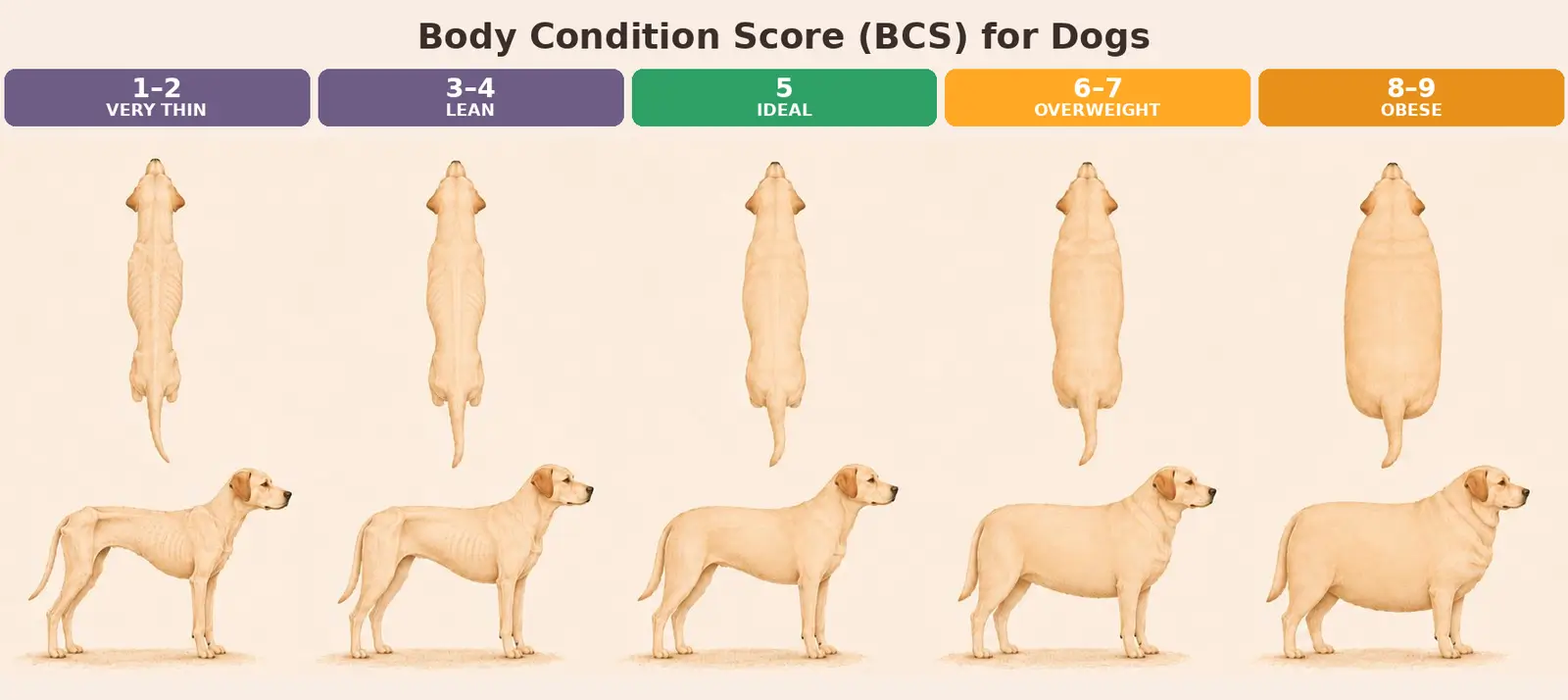
If your dog scores in the overweight or obese range, the next step is not a crash diet. It is a sensible, gradual plan, ideally agreed with your vet, and our guidance on helping an overweight dog safely walks through the options.
Why Most Owners Misjudge Their Dog’s Weight
Most owners genuinely cannot tell when their dog is overweight, and this is one of the best-documented findings in the field. It is not carelessness; it is a perception problem, and understanding it is the reason a structured check is worth doing.
In a UK study of 110 dog owners, most incorrectly estimated their own dog’s body condition, and underestimation was overwhelmingly the most common error.³ Strikingly, the same study found that simply handing owners a body condition chart did not fix the problem: accuracy was essentially unchanged whether or not they used the chart, even though most owners believed the chart had helped them.³ A static chart, on its own, is not enough.
The reason appears to be that our sense of what a “normal” dog looks like has drifted. As overweight dogs have become more common, the overweight shape has come to look normal, so a genuinely lean, healthy dog can look underfed to an eye that has recalibrated. A French study of over 300 dogs found around a quarter of owners underestimated their pet’s condition, and framed it as part of a wider need for a joined-up approach to pet health.⁴
The encouraging part is that this is fixable. The Swedish education study found that a short, hands-on lesson in using the nine-point scale brought owners up to professional-level accuracy.² The problem is not that owners cannot learn to see it. It is that a glance, or even a chart, does not teach it, whereas a guided, hands-on method does. That is precisely the gap the Bonza Dog Body Condition Check is built to close.
Body Condition Score Versus Muscle Condition Score
Body condition score and muscle condition score are two different things, and confusing them can mask a real problem. Body condition score measures fat. Muscle condition score assesses muscle mass, typically over the spine, skull, shoulder blades, and hips, and is graded separately as normal, mild, moderate, or severe loss.
The two can move independently. A dog can carry excess fat while quietly losing muscle, particularly older dogs, so a dog that looks an “ideal” weight can still be losing condition in a way that matters. This is why the feel of your dog, and changes over time, tell you more than a single glance, and why muscle loss in particular is a conversation to have with your vet rather than something to manage at home.
Body Condition vs Muscle Condition
These are two different measures, and a dog can change on one without changing on the other. Knowing the difference helps you spot a problem that body condition alone would miss.
Body Condition Score (BCS)
Measures how much fat covers the body. Scored 1 to 9, with 4 to 5 ideal. This is what the chart above assesses, and what you can check at home by sight and feel.
Muscle Condition Score (MCS)
Assesses how much muscle the dog carries, felt over the skull, spine, shoulder blades and hips. Graded as normal, or mild, moderate or severe loss, rather than on a number scale.
The two can move independently. A dog can carry excess fat while quietly losing muscle, which is especially common in older dogs, so a dog that looks an ideal weight can still be losing muscle in a way that matters. Because muscle loss often signals an underlying health issue, muscle condition is best assessed by your vet, who can examine your dog and investigate the cause. If you notice your dog feels bonier over the spine, shoulders or hips even though their weight seems steady, it is worth a vet visit.
How Body Condition Connects to Whole-Dog Health
Body condition is not just a cosmetic or a single-system concern; it connects to your dog’s whole-body health, and increasingly to what we understand about the gut. Excess body fat is linked to a range of health problems, and maintaining an ideal condition is one of the most effective things an owner can do for a dog’s long-term wellbeing and healthspan.
There is also a growing scientific picture connecting the gut microbiome to how the body regulates weight and metabolism, the gut-metabolic axis. The community of microbes in a dog’s gut plays a part in how energy is extracted from food and how metabolism is regulated, which is why weight management is best understood as part of whole-dog health rather than a calorie equation in isolation. Diet quality, fibre, and the balance of the gut all feed into the bigger picture. This is the principle behind Bonza’s “One Gut. Whole Dog.” approach: the gut sits at the centre of a web of connected systems, and body condition is one visible expression of that web. You can read more in our guide to the gut-metabolic axis in dogs and the wider gut microbiome.
How Often to Check and What to Do Next
Check your dog’s body condition about once a month, more often if you are actively working toward a target. Monthly is frequent enough to catch a gradual drift early, before a few extra pounds become a real problem, and infrequent enough that normal fluctuation does not mislead you. Tracking the trend over time is far more informative than any single score, which is why the Bonza Dog Body Condition Check lets you save and revisit results.
What you do next depends on where your dog sits. If they are ideal, keep doing what you are doing, feed consistent measured portions, and recheck monthly. If they are underweight, or have lost weight without explanation, see your vet, as this can signal an underlying issue. If they are overweight or obese, the goal is gradual, safe change rather than rapid restriction, and your vet can help you set a target and a sensible rate of loss. Our dedicated guidance on helping an overweight dog covers the practical steps, from portion control to building activity.
One Gut. Whole Dog. A healthy body condition is one of the clearest windows into a dog’s overall health, and it is something every owner can learn to read.
Frequently Asked Questions
You can tell by checking three things rather than relying on the scales: look from above for a waist, look from the side for a tucked-up tummy, and feel along the ribs. If the waist and tuck are hard to see and you have to press firmly to feel the ribs, your dog is likely overweight. Because most owners underestimate this, a structured check or a guided tool gives a more honest answer than a glance.
On the nine-point scale the ideal is 4 to 5, and on the five-point scale it is around 3. At the ideal, you can feel your dog’s ribs easily with light pressure, see a waist from above, and see an abdominal tuck from the side.
From above, a healthy weight dog narrows at the waist behind the ribs. From the side, the belly tucks up toward the hind legs. The ribs are not visibly sticking out, but they are easy to feel. An ideal dog often looks a little leaner than owners expect.
No. Weight is a single number; body condition score assesses how much fat covers the body, which is a more reliable indicator of health. Two dogs of identical weight can have very different body conditions, and breed weight ranges are not a reliable guide to ideal condition.¹
About once a month for most dogs, and more often if you are working toward a weight target. Checking the trend over time matters more than any single result.
Because owner perception of “normal” has drifted as overweight dogs have become more common, so a healthy lean dog can look underfed and an overweight dog can look normal. Research consistently shows owners underestimate their dog’s condition, and that even a chart does not fix it, whereas hands-on education does.²,³
Yes, and on a heavily coated dog the rib feel is the check to rely on, because the coat hides the waist and tuck from view. Place both hands flat over the rib cage behind the front legs and note how much pressure you need to feel the ribs. When what you see and what you feel disagree, trust your hands.
It is the upward and backward sweep of the belly line behind the rib cage when viewed from the side. A clear tuck is a feature of an ideal weight dog; a belly that hangs level or sags indicates excess fat.
Conclusion
The most useful thing this guide can leave you with is a small shift in habit: stop checking whether your dog “looks about right,” and start checking what you can feel. The evidence is unambiguous that the glance misleads us, almost always in the same direction, and that even a reference chart does not correct it. What does correct it is a structured, hands-on method practised regularly, the same method a vet uses, which any owner can learn in minutes.
Body condition is one of the clearest, earliest, and most controllable signals of a dog’s overall health. Catching a drift early is far easier than reversing established obesity, and the simple monthly habit of looking and feeling, rather than guessing, is genuinely one of the highest-value things you can do for your dog’s healthspan. That is the whole-dog view, and a healthy body condition is one of its plainest expressions. Check your dog with the Bonza Dog Body Condition Check, learn what ideal feels like, and make it a healthy habit.
This article is for informational purposes only and does not constitute veterinary advice. Always consult a qualified veterinarian before making changes to your dog’s diet or supplement regimen.
References
- Smith S, German AJ, Holden SL, et al. Canine recommended breed weight ranges are not a good predictor of an ideal body condition score. J Anim Physiol Anim Nutr. 2018;102(6):1452-1459. doi: 10.1111/jpn.12919
- Gille S, Fischer H, Lindåse S, Palmqvist L, Lärka J, Wolf S, Penell J, Söder J. Dog Owners’ Perceptions of Canine Body Composition and Effect of Standardized Education for Dog Owners on Body Condition Assessment of Their Own Dogs. Vet Sci. 2023;10(7):447. doi: 10.3390/vetsci10070447. PMC: PMC10386090.
- Eastland-Jones RC, German AJ, Holden SL, Biourge V, Pickavance LC. Owner misperception of canine body condition persists despite use of a body condition score chart. J Nutr Sci. 2014;3:e45. doi: 10.1017/jns.2014.25. PMC: PMC4473163.
- Blanchard T, Hoummady S, Banuls D, Roche M, Bynens A, Meunier M, Dos Santos N, Tissaoui E, Rouch-Buck P, Fantinati M, Priymenko N. The Perception of the Body Condition of Cats and Dogs by French Pet Owners and the Factors Influencing Underestimation. Animals (Basel). 2023;13(23):3646. doi: 10.3390/ani13233646. PMC: PMC10705725.
Editorial Information
| Field | Detail |
|---|---|
| Published | 29 May 2026 |
| Last Updated | 29 May 2026 |
| Reviewed by | Veterinary Advisory Board |
| Next Review | May 2027 |
| Author | Glendon Lloyd, Dip. Canine Nutrition (Dist.), Dip. Dog Nutrigenomics (Dist.), Founder, Bonza |
| Disclaimer | This article is for informational purposes only and does not constitute veterinary advice. Always consult a qualified veterinarian before making changes to your dog’s diet or supplement regimen. |