

Summary
Choosing a sustainable dog food is harder than it looks, because almost every brand now claims to be eco-friendly on the strength of a single feature. This guide sets out a clear, six-dimension framework for judging what genuinely makes a dog’s food sustainable, covering protein source, ingredients and sourcing, processing, packaging, active environmental contribution and company governance. You will see why plant-based diets carry the lowest environmental footprint of any category, what the latest UK research shows about greenhouse gas emissions, and how to tell a serious commitment from a marketing claim. By the end you will be able to assess any dog food on its real impact, from the bowl to the planet.
Quick Reference
At a Glance
- Sustainable dog food is best judged across six dimensions: protein source, ingredients and sourcing, processing, packaging, active contribution and governance.
- Plant-based diets produce the lowest environmental impact of any dog food category. Recent UK research found they generate up to ten times fewer greenhouse gas emissions than red-meat diets.
- A single eco-friendly feature, such as recyclable packaging, does not make a food sustainable. Real sustainability runs the full length of the supply chain.
- The clearest signals of a serious brand are measurable environmental contribution and a mission protected in the company’s legal structure.
Key Insight
Most dog food is marketed as eco-friendly on one feature alone. Judging a food across all six dimensions is the only reliable way to separate genuine sustainability from a green label.
The pet food aisle has gone green. Recyclable pouches, leaf logos and words like “natural”, “ethical” and “eco” now sit on packs that, underneath, are made in much the same way they always were. For an owner who wants to do right by both their dog and the planet, this is a confusing place to shop, because the loudest claim is rarely the most meaningful one.
The honest answer is that sustainability is not a single feature you can print on a bag. It is the sum of many decisions, made from the moment an ingredient is grown to the moment a company decides what to do with its profits. A food can use recyclable packaging and still be built on one of the most resource-intensive proteins on earth. Another can be plant-based yet say nothing about where its crops come from.
This guide gives you a framework to cut through that noise. It explains the real scale of dog food’s environmental footprint, sets out the six dimensions that together define a genuinely sustainable diet, and shows how to apply them to any product on the shelf.
Key Takeaways
- Dog food is a serious environmental issue, not a marginal one. The pets of a single large nation can rival the meat consumption of an entire mid-sized country.
- Protein source is the biggest single lever. Switching from red meat to plant proteins delivers by far the largest reduction in a diet’s footprint.
- Sustainability spans six dimensions. A food that scores well on packaging but poorly on protein and sourcing is not truly sustainable.
- Plant-based diets can be complete and safe when formulated to recognised nutritional standards. Adequacy depends on formulation, not on the absence of meat.
- The strongest credibility signals are funded, measurable contribution and a sustainability mission written into a company’s legal constitution.
In This Guide
- What Makes Dog Food Sustainable?
- How Big Is the Environmental Footprint of Dog Food?
- The Six Dimensions of Sustainable Dog Food
- Why Bonza Is Built for a Healthier Planet
- Is Plant-Based Dog Food Safe and Nutritionally Complete?
- How to Choose a Sustainable Dog Food
- Frequently Asked Questions About Sustainable Dog Food
- Conclusion
- References
- Editorial Information
What Makes Dog Food Sustainable?
A dog food is sustainable when its full life cycle, from the crops or animals it is made of through to the company that sells it, places the lowest reasonable burden on the environment while still meeting a dog’s nutritional needs. Sustainability is therefore a property of the whole supply chain, not of any single ingredient or feature.
This matters because the word is so easily misused. A pack can carry a recyclable symbol, a green colour scheme and a tree on the front while the food inside is built on beef, the most carbon-intensive protein in the human and pet food system. The recyclable pouch is real, but it addresses one of the smallest parts of the food’s total impact.
To judge sustainability properly, you have to look across several dimensions at once and ask where the food sits on each. The rest of this guide breaks those dimensions down so you can do exactly that.
How Big Is the Environmental Footprint of Dog Food?
The environmental footprint of feeding dogs is far larger than most owners assume. Pets are not a rounding error in the food system; they are a meaningful part of it.
The landmark analysis here is Gregory Okin’s 2017 study, which calculated that if the cats and dogs of the United States formed their own nation, that nation would rank fifth in the world for meat consumption.¹ The same work estimated that American pets are responsible for the equivalent of around 64 million tonnes of carbon dioxide a year through their diet alone, and account for roughly a quarter to a third of the environmental impact of animal production in the country.¹ A broader global assessment of the pet food industry reached similar conclusions about the scale of the sector’s “paw print”.²
Most of that impact comes from a single source: animal-derived ingredients. Agriculture as a whole is responsible for close to a quarter of global greenhouse gas emissions, and within agriculture, livestock is the dominant driver. Beef and dairy production generate far more emissions per unit of food than crops, while using a disproportionate share of the world’s farmland and fresh water.
This is why the protein a food is built on matters more than almost anything else, and why it sits first in the framework below.
The Six Dimensions of Sustainable Dog Food
Genuine sustainability is best assessed across six connected dimensions. A food that performs well on one but poorly on the others is not sustainable, however it is marketed. Used together, these dimensions give you a single, repeatable way to judge any product.
The six dimensions are:
- Protein source, the largest single driver of a food’s footprint.
- Ingredients and sourcing, covering crop choice and supply transparency.
- Processing and energy, or how the food is made.
- Packaging and circularity, or how the food is delivered and disposed of.
- Active contribution, or what a brand puts back into the environment.
- Governance and accountability, or how a company protects its mission over time.
Protein Source: Why Plant Proteins Have the Lowest Footprint
The protein a dog food is built on is the single biggest driver of its environmental impact. Animal proteins, especially beef and lamb, carry by far the highest burden, while plant proteins carry the lowest.
The clearest recent evidence comes from a 2025 University of Nottingham study that assessed thirty-one dry dog foods sold in the United Kingdom using life cycle analysis.³ It found that plant-based diets had the lowest impact across every measure tested, including land use, greenhouse gas emissions, water use and pollution of soil and waterways. Per 1,000 kilocalories, plant-based foods produced roughly 2.8 kg of carbon dioxide equivalent, compared with around 31 kg for beef-based foods, a difference of more than tenfold.³
Insect-based diets, offered by some brands as a lower-impact alternative to conventional meat, do sit below red meat on most measures. They remain an animal-derived input, however, with their own feed, water and energy requirements, and in the UK analysis plant-based diets remained the lowest-impact category overall.³ For owners whose priority is the smallest possible footprint, plant proteins are the strongest choice.
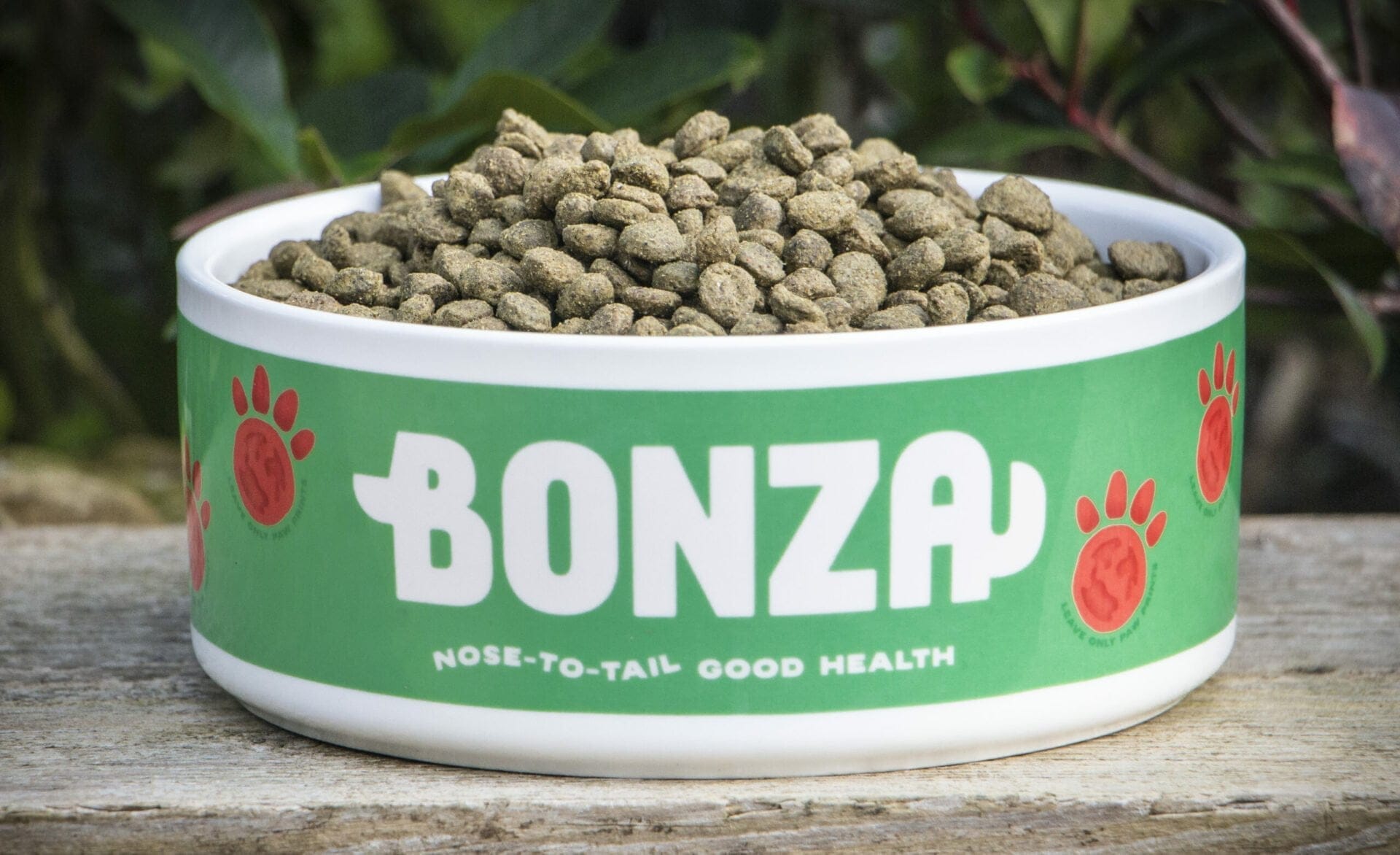
Bonza is built entirely on plant-based nutrition for exactly this reason. The diet also draws its omega-3 and omega-6 fatty acids from marine algae and plants rather than fish, which avoids adding pressure on wild fish stocks, and sources glucosamine, with chondroitin in the Bioactive Bites, from plant and algae rather than shellfish or other animals.
Ingredients and Sourcing: Climate-Smart Crops and Honest Traceability
A sustainable ingredient list does two things at once: it favours crops that are good for the land, and it is honest about where those crops come from.
Conventional pet food leans heavily on a small set of monocrops, with maize, soya, wheat and rice supplying a large share of plant calories worldwide. Reliance on so few crops drives deforestation, depletes soils and increases pesticide use, and rice in particular is a significant source of methane. Replacing them with more varied, lower-impact crops reduces all of these pressures at the same time.
The most sustainable foods favour what are sometimes called climate-smart crops. These include legumes such as peas and lentils, which fix nitrogen in the soil and improve the yield of crops that follow them; ground-cover crops such as oats, which protect against erosion; and resilient root and tuber crops such as sweet potato, alongside quinoa. Bonza contains no maize, soya, wheat or rice, and selects ingredients chosen for their ability to improve soils, support biodiversity and strengthen food security.
The second half of this dimension is traceability. A genuinely sustainable brand can tell you, in plain terms, what is in the food and broadly where it comes from, rather than hiding behind generic descriptions. When you assess a product, look for clearly named ingredients and a brand that is willing to explain its sourcing, not just its claims.
Processing and Energy: What Cold Extrusion Changes
How a food is cooked affects both its environmental footprint and its nutritional value, and the two are linked. Conventional dry dog food is made by high-temperature extrusion, which relies on a considerable input of water in the form of steam to cook ingredients under heat and pressure, followed by an energy-intensive drying stage to remove that moisture again.
Bonza uses cold extrusion instead, a gentler method that cooks at temperatures no higher than 70°C. Because it does not depend on high-pressure steam or the same intensive drying, it uses less water and less energy than conventional extrusion, which means lower emissions and a smaller processing footprint. The lower temperature also protects heat-sensitive nutrients, including some vitamins, plant phytonutrients and the omega-3 fatty acids that more aggressive processing can degrade, so more of what goes into the food survives into the bowl.
For owners weighing sustainability, the point is that a food’s footprint is shaped not only by what is in it but by how it is made. Gentler, lower-resource processing is part of a considered approach rather than an afterthought.
Packaging and Circularity: Designing Out Waste
Packaging is the most visible sustainability feature and the easiest one to lean on too heavily. It matters, but it is only one part of a food’s total impact.
The right approach is to design waste out of the system: to use recyclable packaging, keep materials in circulation and avoid unnecessary plastic. Bonza’s packaging is recyclable, which is the standard a responsible brand should meet.
The key thing to remember is that packaging is necessary but not sufficient. A recyclable pouch around a beef-based food still leaves the largest part of the footprint untouched. Treat packaging as a hygiene factor that a serious brand gets right, rather than as proof of sustainability on its own.
Active Contribution: How Every Bag and Subscription Protects Forests
The most credible brands do not simply reduce harm; they actively fund environmental restoration with every sale. This shifts a company from doing less damage to making a positive contribution.
Bonza builds this into how it trades. Every bag contributes, through 1% for the Planet, to Trees for the Future’s Forest Garden programmes, which support some of the communities most exposed to climate change while restoring degraded land. Every subscription delivery goes further: through the One Tribe platform it helps Rainforest Trust protect 400 square metres of rainforest, preserving around twenty trees, storing an estimated 9.8 tonnes of carbon dioxide and removing a further 0.4 tonnes from the atmosphere each year.
These are specific, measurable commitments rather than vague pledges, and that specificity is the point. When you assess a brand on this dimension, ask whether its contribution is named, measurable and tied to each purchase, or whether it is a general statement with no figures attached.
Governance and Accountability: Putting Mission Into the Constitution
A sustainability mission is only as durable as the legal structure that protects it. Founders change their minds, companies are sold and priorities drift, so the strongest signal of a lasting commitment is one written into a company’s constitution.
Bonza, trading through Happea Chappea Limited, has enshrined the following in its Articles of Association:
The objects of the Company are to promote the success of the Company; (i) for the benefit of its members as a whole; and (ii) through its business and operations, to have a material positive impact on (a) society and (b) the environment, taken as a whole.
This commitment is reinforced in two further ways. The company is working toward B Corporation certification, the recognised standard for businesses that meet high verified standards of social and environmental performance. And its work is aligned to five of the United Nations Sustainable Development Goals:
Governance is the dimension most brands ignore, because it is the hardest to fake. When a mission is legally binding rather than a marketing line, it is far more likely to survive contact with commercial pressure.
Why Bonza Is Built for a Healthier Planet
Bonza is one of the few dog foods designed to perform across all six dimensions at once, rather than excelling at one and staying quiet about the rest.
The diet is fully plant-based, placing it in the lowest-impact protein category.³ It avoids the resource-heavy monocrops of maize, soya, wheat and rice in favour of climate-smart crops, and draws its omegas and joint-support nutrients from marine algae and plants rather than fish or shellfish. It is made using lower-temperature cold extrusion that uses less water and energy than conventional methods, delivered in recyclable packaging, and paired with funded restoration through 1% for the Planet, Trees for the Future, One Tribe and Rainforest Trust. Underpinning all of it is a sustainability mission written into the company’s Articles of Association and a path toward B Corp certification.
Healthier Dogs. Healthier Planet.
This is the practical expression of Bonza’s founding belief that what is good for a dog and what is good for the planet are not in tension. The same philosophy that drives the brand’s nutritional thinking, captured in the principle that there is One Gut. Whole Dog., extends outward to the environment the dog lives in.
Is Plant-Based Dog Food Safe and Nutritionally Complete?
Plant-based dog food can be safe and nutritionally complete, provided it is formulated to meet established canine nutritional standards. The important factor is the quality of the formulation, not the presence or absence of meat.
Dogs are metabolically flexible omnivores rather than obligate carnivores, and they can obtain every nutrient they need from a well-designed plant-based diet that meets recognised standards such as those set by FEDIAF in Europe. A nutritionally sound diet supplies complete protein with all essential amino acids, the correct fatty acids, and adequate vitamins and minerals, whatever the source of those nutrients.
The evidence base here is growing and reassuring. A large guardian-reported study of more than two thousand dogs found that those fed nutritionally sound vegan diets showed health indicators at least as good as those fed conventional meat diets.⁴ A separate year-long clinical study, which measured blood chemistry, amino acid levels and other objective markers, found that dogs maintained their clinical, nutritional and haematological health on a complete plant-based diet over twelve months.⁵
A note of balance is important. Not every plant-based food is well formulated, and a poorly balanced diet of any type, meat-based or plant-based, can fall short. This is why nutritional adequacy to a recognised standard, rather than the marketing on the front of the pack, is what matters. As with any significant change to your dog’s diet, particularly if your dog has an existing health condition, it is sensible to consult your vet before switching. A sustainable diet is intended to support your dog’s overall health, not to treat or cure any specific condition.
How to Choose a Sustainable Dog Food
You can assess any dog food by working through the six dimensions in order. The following steps turn the framework into a practical shopping checklist.
- Start with the protein.
Identify what the food is built on. Plant proteins carry the lowest footprint, followed by insect protein, with red meat the highest. This single decision has the largest effect on impact.
- Read the ingredient list.
Look for varied, climate-smart crops and the absence of resource-heavy fillers such as maize (corn), soya, wheat and rice.
- Check for traceability.
Favour brands that name their ingredients clearly and are willing to explain where they come from, rather than relying on vague terms.
- Look beyond the packaging.
Confirm the packaging is recyclable, then remember that this is a baseline expectation, not proof of sustainability on its own.
- Ask what the brand puts back.
Look for funded, measurable environmental contribution tied to each purchase, with real figures rather than general statements.
- Check the governance.
The strongest brands protect their mission in their legal structure and pursue independent standards such as B Corp certification.
A food that satisfies all six is genuinely sustainable. A food that satisfies only one, however loudly it advertises that one, is not.
Frequently Asked Questions About Sustainable Dog Food
Yes. Plant-based diets have the lowest environmental footprint of any dog food category. A 2025 UK life cycle study found they produced the least impact across land use, greenhouse gas emissions, water use and pollution, generating roughly ten times fewer emissions than beef-based diets.³
A well-formulated plant-based diet, made from climate-smart crops, processed gently, delivered in recyclable packaging and backed by funded environmental contribution, is currently the most eco-friendly option available. No single feature defines it; the combination across all six dimensions does.
No. Recyclable packaging is a baseline expectation, but it addresses only a small part of a food’s total footprint. A recyclable pack around a high-impact protein still leaves the largest source of impact in place.
Insect protein has a lower footprint than conventional meat and is a genuine improvement on red meat. It remains an animal-derived input with its own resource demands, however, and in UK research plant-based diets had the lowest impact of any category.³
It can be, when the diet is formulated to meet recognised nutritional standards such as FEDIAF. Studies of dogs fed nutritionally sound plant-based diets have found health outcomes comparable to meat-based diets over time.⁴ ⁵ Speak to your vet before making a significant dietary change.
It means a company is going through the rigorous, independent assessment required for B Corporation certification but has not yet completed it. It signals that a brand is willing to have its social and environmental performance verified against a recognised external standard.
Conclusion
Conclusion: The green pet food aisle asks owners to make an important decision with very little reliable information. Brands compete to own a single eco-friendly feature, and the result is a marketplace where a recyclable pouch can stand in for genuine sustainability and the largest source of a food’s impact, its protein, goes unmentioned.
The six-dimension framework is designed to fix that. By asking the same six questions of every food, about protein, ingredients and sourcing, processing, packaging, contribution and governance, you can judge any product on its real impact rather than its marketing. Measured this way, the most sustainable choice is consistent: a well-formulated, plant-based diet, made and delivered thoughtfully, sold by a company that funds restoration and protects its mission in its own constitution.
That is the standard Bonza was built to meet, in the conviction that the health of our dogs and the health of the planet rise and fall together.
Healthier Dogs. Healthier Planet.
Related Reading
- Plant-Based Dog Food: The Bonza Superfoods Range
- Can Dogs Be Plant-Based? What Vets and Nutritionists Say
- The Environmental Impact of Food and Agriculture
- Eco-Friendly, Recyclable Dog Food Packaging
- The Gut-Longevity Axis in Dogs: Key to Improved Healthspan
References
- Okin GS. Environmental impacts of food consumption by dogs and cats. PLoS ONE. 2017;12(8):e0181301. doi: 10.1371/journal.pone.0181301. PMID: 28767700. PMC: PMC5540283.
- Alexander P, Berri A, Moran D, Reay D, Rounsevell MDA. The global environmental paw print of pet food. Glob Environ Chang. 2020;65:102153. doi: 10.1016/j.gloenvcha.2020.102153.
- Brociek RA, Gardner DS. Environmental impact of feeding plant-based vs. meat-based dry dog foods in the United Kingdom. Front Sustain Food Syst. 2025;9:1633312. doi: 10.3389/fsufs.2025.1633312.
- Knight A, Huang E, Rai N, Brown H. Vegan versus meat-based dog food: Guardian-reported indicators of health. PLoS ONE. 2022;17(4):e0265662. doi: 10.1371/journal.pone.0265662. PMID: 35417464. PMC: PMC9007375.
- Linde A, Lahiff M, Krantz A, Sharp N, Ng TT, Melgarejo T. Domestic dogs maintain clinical, nutritional, and hematological health outcomes when fed a commercial plant-based diet for a year. PLoS ONE. 2024;19(4):e0298942. doi: 10.1371/journal.pone.0298942. PMID: 38625934. PMC: PMC11020905.
Editorial Information
| Field | Detail |
|---|---|
| Published | 8 June 2026 |
| Last Updated | 8 June 2026 |
| Reviewed by | Veterinary Advisory Board |
| Next Review | 8 June 2027 |
| Author | Glendon Lloyd, Dip. Canine Nutrition (Dist.), Dip. Dog Nutrigenomics (Dist.), Founder, Bonza |
| Disclaimer | This article is for informational purposes only and does not constitute veterinary advice. Always consult a qualified veterinarian before making changes to your dog’s diet or supplement regimen. |