Panax Ginseng for Dogs: A Core Adaptogen for Stress, Cognition, and Senior Vitality
Most "ginseng for dogs" supplements use the wrong species. The science-led canine guide to Panax ginseng covers what ginsenosides really do, the canine RCT evidence in senior dogs, and why this Core adaptogen earns its place in PhytoPlus®.
Panax Ginseng for dogs is one of only six Core strict-definition adaptogens, distinguished by ginsenosides (a class of triterpene saponins) that modulate the hypothalamic-pituitary-adrenal axis bidirectionally. Direct canine evidence remains modest but meaningful: a 2007 randomised controlled trial in 80 geriatric dogs documented significant improvements in mental and cognitive variables after eight weeks of supplementation, and a 2025 canine reproductive trial in Beagles documented improvements in sperm motility without adverse effects. In vitro canine studies confirm ginseng total saponin enhances phagocytic immune capacity through TNF-α signalling. Translational evidence from human and rodent research supports cognitive, antioxidant, anti-fatigue, and gut-microbiome benefits via ginsenosides Rb1, Rg1, and Rg3. Bonza includes Panax Ginseng in the PhytoPlus® botanical blend within Superfoods & Ancient Grains, alongside Ashwagandha, Eleuthero, and Reishi.
AT A GLANCE
What Panax Ginseng does for dogs
Panax Ginseng is one of six Core strict-definition adaptogens, with bidirectional cortisol modulation as the canonical example of normalising action.
Ginsenosides (Rb1, Rg1, Rg3 and others) are the principal bioactive compounds, classed as triterpene saponins.
Direct canine evidence includes an 8-week RCT in 80 geriatric dogs and a 60-day Beagle reproductive trial, alongside in vitro canine immune work.
Translational research supports cognitive, antioxidant, anti-fatigue, and gut-microbiome effects through HPA-axis and TLR4/NF-κB pathways.
Ginseng appears in the PhytoPlus® botanical blend within Bonza Superfoods & Ancient Grains, the only UK plant-based dog food to include four strict-definition adaptogens.
Veterinary input is sensible for dogs on cardiovascular, anticoagulant, or psychotropic medication, and during pregnancy or lactation.
Key insight
Most botanicals labelled “adaptogen” are not. Panax Ginseng is. Its bidirectional action on the HPA axis, with the same compound supporting stressed dogs and depleted dogs in opposite physiological directions, is the textbook definition of normalising pharmacology.
Most products marketed as “ginseng for dogs” do not contain Panax ginseng. They contain Eleuthero (Eleutherococcus senticosus), historically called Siberian ginseng but botanically a different plant in the same family with overlapping but distinct pharmacology. Panax Ginseng is the original ginseng, used in East Asian medicine for over two thousand years and among the earliest plants to be formally classified as an adaptogen in Soviet pharmacology in the mid-twentieth century. It now sits in the small group of six Core strict-definition adaptogens, alongside Ashwagandha, Rhodiola, Eleuthero, Schisandra, and Holy Basil.¹,² Many botanicals marketed as adaptogens do not meet the three pharmacological criteria that define the category. Panax Ginseng meets all three.
This article covers the canine-specific evidence base for ginseng, the underlying pharmacology of ginsenosides, the gut-organ axes through which ginseng exerts its effects, and the safety considerations relevant to dogs. It is the ingredient article that supports the Adaptogenic Herbs for Dogs hub and explains why Bonza includes Panax Ginseng in the PhytoPlus® botanical blend within Superfoods & Ancient Grains.
Key Takeaways
Panax Ginseng meets the strict pharmacological definition of an adaptogen, with bidirectional HPA-axis modulation as its defining feature.
Ginsenosides Rb1, Rg1, and Rg3 are the principal bioactives, undergoing gut-microbiome biotransformation into compound K with 3-to-5-fold increases in bioavailability.
The strongest canine direct evidence is the Hielm-Björkman 2007 RCT in 80 geriatric dogs, with significant cognitive and mental-state improvements over 8 weeks.
In vitro canine work shows ginseng total saponin enhances phagocyte function via TNF-α, supporting an immunomodulatory mechanism in dogs specifically.
A 2025 canine reproductive trial in Beagles documented improvements in sperm motility from black ginseng supplementation without adverse effects.
Ginseng modulates the gut-brain, gut-immune, and gut-longevity axes, with the gut microbiome serving as both a target and a metaboliser of ginsenosides.
Bonza includes Panax Ginseng in PhytoPlus® within Superfoods & Ancient Grains, alongside Ashwagandha, Eleuthero, and Reishi.
Veterinary input is appropriate for dogs on cardiovascular, anticoagulant, or psychotropic medication, in pregnancy and lactation, and in toy breeds at extreme low body weight.
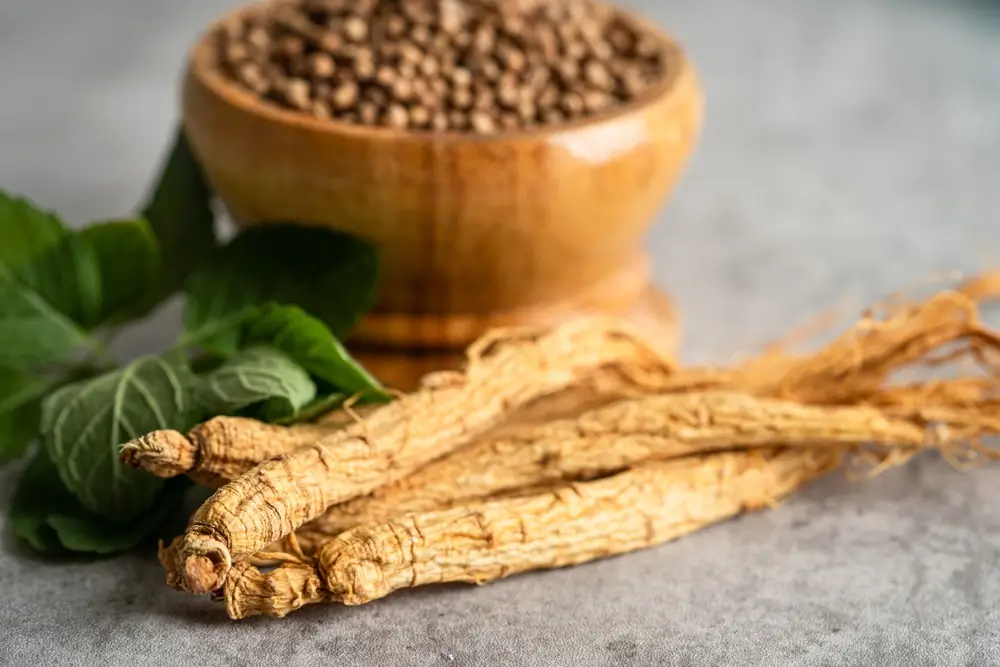
Panax Ginseng (Panax ginseng C.A. Meyer) is a perennial plant in the Araliaceae family native to mountainous regions of Korea, north-eastern China, and far-eastern Russia. The dried root is the medicinal part, and it is the historical reference plant for the entire adaptogen category. Panax Ginseng has been included in major pharmacopoeias including the European Pharmacopoeia, the Japanese Pharmacopoeia, and the former USSR Pharmacopoeia, as a recognised adaptogenic herb.³
The name Panax derives from the Greek panakeia, meaning “all-healing”, reflecting the breadth of traditional use. In modern pharmacology, that breadth makes biological sense: ginseng acts as a systemic modulator rather than as a single-target agent, with effects on the hypothalamic-pituitary-adrenal axis, the cardiovascular system, the immune system, the gut microbiome, and the central nervous system.¹,²,³ For dogs, the practical consequence is that ginseng is best understood as a daily resilience-and-vitality ingredient rather than a targeted symptom treatment.
Three things separate Panax Ginseng from the many botanicals marketed as ginseng but unrelated taxonomically. First, only Panax species (P. ginseng, P. quinquefolius, P. notoginseng) belong to the genuine Panax genus. Eleuthero (Eleutherococcus senticosus, often called Siberian Ginseng) is a different plant in the same family with overlapping but distinct pharmacology. Second, the ginsenoside profile is genus-specific to Panax and is the basis of standardisation in commercial extracts. Third, processing matters: white ginseng (sun-dried), red ginseng (steamed and dried), and black ginseng (repeated steaming) yield different ginsenoside ratios and different pharmacological emphases.⁴
Ginsenosides and the Bioactive Profile of Panax Ginseng
Ginsenosides are the principal bioactive compounds in Panax Ginseng and the chemical basis of its adaptogenic action. They are a class of triterpene saponins with a steroid-like four-ring backbone, and the structural similarity to endogenous steroid hormones underpins their interaction with the HPA axis.³ Approximately 40 individual ginsenosides have been isolated to date, with Rb1, Rg1, and Rg3 the most pharmacologically characterised.⁵
The principal ginsenosides each carry distinct functional emphases:
Ginsenoside Rb1 is the most abundant ginsenoside in white ginseng and the principal driver of cognitive, anti-fatigue, and anti-aging effects in translational models. It increases hippocampal glutamatergic transmission, supports synaptic plasticity, and reduces oxidative stress in muscle tissue.⁵
Ginsenoside Rg1 is well documented for neuroprotective, neurotrophic, and cognition-enhancing activity. It crosses the blood-brain barrier and has been investigated extensively in models of Alzheimer’s disease, vascular dementia, and chemotherapy-related cognitive impairment.⁵,⁶
Ginsenoside Rg3 is enriched in red and black ginseng (formed during steam processing) and is associated with anti-inflammatory, anti-tumour, and gut microbiome-modulating effects. It is one of the principal substrates for biotransformation to compound K by gut bacteria.⁵
Compound K is the principal active metabolite formed by gut bacterial deglycosylation of Rb1, Rb2, Rb3, Rc, and Rd. It exhibits 3-to-5-fold higher bioavailability than the parent ginsenosides and is responsible for much of the systemic effect after oral administration.⁵
The processing form of ginseng matters because the steaming process used to make red and black ginseng partially hydrolyses the parent ginsenosides to deglycosylated forms, including Rg3, Rh1, and compound K precursors. This is why red ginseng and black ginseng often outperform white ginseng on specific endpoints despite being derived from the same plant.⁴
The Documented Benefits of Panax Ginseng for Dogs
The documented benefits of Panax Ginseng for dogs cover four principal areas: stress and HPA-axis modulation, cognitive and mental performance in senior dogs, immune resilience, and physical performance and recovery. Direct canine evidence is more limited than for some other adaptogens such as Ashwagandha, but three peer-reviewed canine studies anchor the evidence base, supplemented by translational evidence from human and rodent research.⁴,⁷
Stress and Bidirectional Cortisol Modulation
Panax Ginseng is the canonical example of bidirectional adaptogenic action. In states of hypercortisolism, ginsenosides downregulate cortisol output. In states of suboptimal adrenal function, they support steroidogenesis.² This bidirectional behaviour is the defining feature of normalising pharmacology and is what separates true adaptogens from herbs that simply sedate or stimulate. The mechanism involves direct interaction of ginsenosides with glucocorticoid receptor pathways and indirect effects on hypothalamic CRH and pituitary ACTH signalling.²,³
Cognitive and Mental Performance, Particularly in Senior Dogs
The strongest direct canine evidence for Panax Ginseng comes from a 2007 randomised controlled study by Hielm-Björkman and colleagues at the University of Helsinki. Eighty geriatric dogs received either ginseng plus brewers’ yeast (n=41) or brewers’ yeast alone (n=39) for eight weeks. Owner-completed questionnaires and visual analogue scales tracked changes from baseline weekly during treatment and at 12-week and 16-week follow-up. Four of seven primary mental-state outcome measures were significantly better in the ginseng group than the control group, and six of seven were significantly better when compared to an external reference group, with no side effects observed across blood and urine analyses.⁷
Translational evidence from human and rodent models reinforces the cognitive picture. Ginsenoside Rg1 has been the subject of a preclinical systematic review covering 32 studies and 1,643 animals, with significant improvement in cognitive behavioural impairments documented across most Alzheimer’s disease models.⁶ The clinical translation in humans includes improved working memory, attention, and mental performance with standardised extracts.⁴
Immune Resilience and Phagocyte Function
Panax Ginseng supports canine immune resilience through documented effects on phagocyte function. A 2008 in vitro study using canine peripheral blood mononuclear cells (PBMC) and polymorphonuclear cells (PMN) showed that ginseng total saponin enhances phagocytic capacity through a TNF-α-mediated mechanism. The phagocytic capacity of PMN and monocytes was significantly increased by culture supernatant from PBMC treated with ginseng total saponin, and the effect was inhibited by anti-TNF-α antibody, confirming TNF-α as the mediating cytokine.⁸ The implication for dogs is that ginseng supports the body’s first-line cellular defence rather than acting as a generic immune stimulant.
Physical Performance, Recovery, and Reproductive Vitality
Translational evidence supports ginseng’s role in physical performance and recovery, mediated by improved mitochondrial function, lower lactate, and reduced oxidative stress in muscle tissue.⁴ A 2025 randomised crossover trial in male Beagle dogs investigated three processed forms of Panax Ginseng (white, red, and black) at 500 mg per day for 60 days. Black ginseng supplementation significantly improved sperm motility and velocity parameters compared to white and red ginseng forms, with no adverse effects on biochemical markers and no change in serum testosterone levels, suggesting effects mediated by mechanisms independent of testosterone regulation.⁹
As one of the four adaptogens in PhytoPlus®, Panax supports stress resilience and senior vitality. It features in Bonza’s plant-based dog food.
How Panax Ginseng Influences the Canine Gut Microbiome and Gut-Organ Axes
Panax Ginseng exerts its systemic effects partly through the gut microbiome, which serves as both a target of ginseng’s action and the principal site of ginsenoside biotransformation into bioavailable metabolites. A 2025 systematic review of 102 studies identified three core gut-related mechanisms: inhibition of the TLR4/NF-κB pathway reducing pro-inflammatory cytokine levels by 40 to 60 percent; upregulation of tight junction proteins (ZO-1 and claudin-4) strengthening intestinal barrier function by 2.3-fold; and selective gut microbiota modulation increasing the relative abundance of Lactobacillus 2.1-fold and Bifidobacterium with parallel increases in short-chain fatty acid production.¹⁰
For canine gut-organ axis health, the relevant routes of effect are the Gut-Brain axis, the Gut-Immune axis, and the Gut-Longevity axis. Each carries a distinct mechanistic emphasis:
Gut-Brain axis (primary). Bacteria-mediated biotransformation of ginsenosides into compound K and other metabolites is the principal route for cognitive and mood-related effects, with HPA-axis cortisol modulation amplified by the microbiome’s role in stress signalling. The Hielm-Björkman 2007 RCT cognitive improvements in geriatric dogs are consistent with this axis being the dominant route.⁷,¹⁰
Gut-Immune axis. Ginseng total saponin enhances canine phagocyte function via TNF-α (Kim 2008), and the systematic review evidence shows ginseng influences gut-associated lymphoid tissue activity through TLR4/NF-κB modulation and microbial metabolite shifts.⁸,¹⁰
Gut-Longevity axis. Bidirectional cortisol regulation reduces allostatic load, while improved tight-junction integrity, antioxidant capacity, and short-chain fatty acid production converge on the gut-microbiome and longevity literature, particularly relevant for senior dogs.¹⁰,¹¹
The bioavailability story is worth emphasising. Ginsenosides as a class have inherently low oral absorption in their parent forms, but gut bacteria from the genera Bacteroides, Bifidobacterium, Eubacterium, Lactobacillus, and others convert the parent compounds into deglycosylated metabolites that absorb efficiently. This means that a healthy gut microbiome is part of how Panax Ginseng works in the first place, which is one reason why ginseng fits naturally into a complete food matrix rich in fibre, prebiotics, and microbial substrates rather than into an isolated supplement.¹⁰
Why Bonza Includes Panax Ginseng in Superfoods & Ancient Grains
Bonza includes Panax Ginseng in the PhytoPlus® botanical blend within Superfoods & Ancient Grains because it completes the strict-definition adaptogen layer that the food is built around. Panax Ginseng sits alongside Ashwagandha, Eleuthero, and Reishi in PhytoPlus®, making Bonza Superfoods & Ancient Grains the only UK plant-based dog food formulated to include four strict-definition adaptogens, three of which (Ashwagandha, Panax Ginseng, Eleuthero) are Core adaptogens.
The pharmacological logic for including ginseng specifically rests on three points:
Bidirectional cortisol modulation. Panax Ginseng is the canonical adaptogen for normalising HPA-axis activity, complementing Ashwagandha’s cortisol-reducing emphasis with a more bidirectional profile that supports both stressed and depleted dogs.²,³
Cognitive support in senior dogs. The Hielm-Björkman 2007 canine RCT remains the strongest direct evidence for ginseng’s effect on cognitive and mental-state variables in older dogs, an area where supplement-based support is genuinely scarce in the canine literature.⁷
Microbiome-mediated systemic action. Ginseng’s reliance on gut bacterial biotransformation for bioavailability fits the Bonza food matrix design, which provides the diverse fibre and prebiotic substrates needed to support a healthy ginseng-metabolising microbiome.¹⁰
The placement is in the food rather than in a stand-alone supplement because adaptogens work most consistently when delivered daily over weeks within a matrix that supports the gut microbiome. PhytoPlus® appears exclusively in Superfoods & Ancient Grains, and Panax Ginseng is one of the four adaptogens delivered through that blend. Dogs receiving the food benefit from low-level, daily, food-matrix exposure to ginseng alongside the other three adaptogens, the fibre matrix, and the broader phytonutrient profile of the formulation.
Safety, Contraindications, and When to Seek Veterinary Input Before Using Ginseng
Panax Ginseng is generally well tolerated in dogs at appropriate doses, but specific contraindications exist and species-appropriate dosing matters. The Hielm-Björkman 2007 canine RCT and the 2025 Beagle reproductive trial both reported no adverse events and no significant changes in haematology, biochemistry, or urinalysis at the doses studied, providing baseline canine safety data.⁷,⁹ The principal cautions are around medication interactions and specific physiological states.
Veterinary input is sensible or essential in the following contexts:
Cardiovascular medication and hypertension. Ginseng can interact with antihypertensive regimens and may affect blood pressure in either direction. Dogs with diagnosed hypertension or on cardiovascular medication should not start ginseng without veterinary review.
Anticoagulant therapy. Ginsenosides can affect platelet aggregation. Dogs on anticoagulant or antiplatelet medication require veterinary supervision.
Hyperthyroidism, kidney disease, or cardiomyopathy. These conditions are veterinary-recognised cautions for ginseng use in companion animals.
Diabetic dogs on glucose-lowering medication. Ginseng has documented effects on glycaemic control and may potentiate the action of glucose-lowering drugs.
Pregnancy and lactation. Insufficient canine safety data exists; avoidance is the appropriate default. Ginsenosides Rb1, Rg1, and Re have been shown to produce embryotoxic effects in rodent whole-embryo cultures, reinforcing this caution.¹²
Concurrent psychotropic or behaviour-modifying medication. Veterinary review is appropriate before combining adaptogens with prescribed behaviour-modifying medication.
Puppies under 12 months and toy breeds at extreme low body weight. Conservative, veterinary-led dosing is appropriate.
The principle to follow with adaptogens generally, and ginseng specifically, is gradual introduction, daily consistent use, and assessment over weeks rather than days. Adaptogenic effects typically develop progressively rather than acutely, and the strongest published canine evidence comes from continuous dosing over six to nine weeks.⁷,⁹
How to Introduce Panax Ginseng into Your Dog’s Routine
Introducing Panax Ginseng into a dog’s routine works best as a gradual, daily addition embedded within food rather than as an episodic supplement, because the pharmacology of ginseng favours sustained low-level exposure over high pulse dosing. The practical steps below apply whether ginseng is being delivered through a complete food such as Bonza Superfoods & Ancient Grains or through a stand-alone canine supplement. The recommended introduction sequence is:
Confirm appropriateness with your veterinarian.
Particularly if your dog is on any concurrent medication, has a diagnosed condition, or is in a life stage flagged in the safety section above.
Choose a standardised source.
Look for ginseng standardised to a defined ginsenoside content (commonly 4 to 7 percent total ginsenosides, or specific Rb1/Rg1 ratios). Standardisation is what separates a reliable raw material from a botanical with high batch-to-batch variation.
Start at half the target dose for the first 7 to 10 days.
This allows for tolerance assessment and identification of any GI sensitivity before reaching full dose.
Mix into food rather than offering separately.
Ginseng’s bioactivity benefits from co-administration with food and from gut-microbial biotransformation, both of which favour delivery in a complete meal context.
Maintain consistent daily dosing for at least 6 to 8 weeks before assessing effect.
Adaptogenic effects accumulate progressively. The published canine RCT evidence is built on 8-week and 60-day continuous dosing periods.⁷,⁹
Document baseline and changes.
Note baseline behaviour, energy, appetite, and stool quality before introduction, and reassess at 4 and 8 weeks. This makes any benefit (or absence of benefit) easier to identify objectively.
For dogs already eating Bonza Superfoods & Ancient Grains, ginseng is included in the daily food matrix at appropriate inclusion levels, alongside Ashwagandha, Eleuthero, and Reishi within PhytoPlus®. No separate supplementation is required for the food’s adaptogenic layer to be active.
Dosage Guidance for Panax Ginseng in Dogs
Dosage guidance for Panax Ginseng in dogs is less well established than for Ashwagandha (where 15 mg/kg of standardised root extract has been used across three canine RCTs) but reasonable parameters can be drawn from the published canine work and the human-dose translation framework. The Hielm-Björkman 2007 RCT used a proprietary ginseng-and-yeast preparation in 80 geriatric dogs over 8 weeks, and the 2025 Beagle reproductive trial used 500 mg per day of processed Panax Ginseng powder in dogs weighing 7 to 12 kg, equating to approximately 40 to 70 mg/kg of crude root powder per day.⁷,⁹
The practical dosing parameters that emerge from this evidence base are:
Whole crude root powder: approximately 25 to 75 mg/kg body weight per day, taken with food, sustained over 6 to 8 weeks minimum. The lower end is appropriate for daily resilience use; the upper end aligns with the published Beagle reproductive trial dose.
Standardised extracts: dose depends on ginsenoside concentration and varies between manufacturers. Follow the manufacturer’s veterinary-specific guidance, and where this is not available, default to the lower end of the equivalent crude-root range.
Food-matrix delivery (Bonza Superfoods & Ancient Grains): daily feeding of the food at the manufacturer’s recommended portion provides the formulated inclusion of ginseng within PhytoPlus®. No additional ginseng dosing is required.
Direct canine dose-finding studies for Panax Ginseng remain a recognised gap in the veterinary literature. Pezzali and Shoveller (2024) explicitly note that empirical canine studies are necessary to validate health benefits and determine safe dosing for ginseng in dogs and cats before widespread inclusion.⁴ The conservative default in the absence of more dose-finding data is to use the lower end of the published canine range, observed over 6 to 8 weeks, with veterinary input where any of the contraindications listed in the safety section apply.
Frequently Asked Questions
Is Panax Ginseng safe for dogs?
Yes, at appropriate doses, Panax Ginseng has a favourable safety profile in dogs. The Hielm-Björkman 2007 canine RCT and the 2025 Beagle reproductive trial both reported no adverse events and no significant changes in blood or urine analyses across 8 weeks and 60 days respectively.⁷,⁹ Specific cautions apply for dogs on cardiovascular, anticoagulant, glucose-lowering, or psychotropic medication, and during pregnancy or lactation.
What is the difference between Panax Ginseng and Siberian Ginseng?
They are different plants with overlapping but distinct pharmacology. Panax Ginseng (Panax ginseng) is in the genus Panax and contains ginsenosides as the principal bioactives. Siberian Ginseng (Eleutherococcus senticosus) is in the same plant family (Araliaceae) but a different genus, and its bioactives are eleutherosides, particularly syringin (eleutheroside B) and syringaresinol diglucoside (eleutheroside E). Both are Core adaptogens, but they emphasise different aspects of stress-response support.¹
How long does Panax Ginseng take to work in dogs?
Most published canine and translational data shows progressive effects over 6 to 9 weeks of daily dosing. The Hielm-Björkman 2007 canine RCT used 8 weeks of dosing with continuing improvement at 12-week and 16-week follow-up. Short courses of 1 to 2 weeks are unlikely to produce the full effect.⁷
Can Panax Ginseng be combined with Ashwagandha for dogs?
Yes, in principle, and Bonza Superfoods & Ancient Grains plant-based dry dog food includes both ingredients within the PhytoPlus® botanical blend. The two adaptogens have complementary profiles: Ashwagandha’s evidence base in dogs is strongest for cortisol reduction and anti-inflammatory effects, while Panax Ginseng’s strongest dog-specific evidence is for cognitive and mental-state support in geriatric dogs and bidirectional HPA-axis modulation.⁷ Combining them in a single food matrix is consistent with the broader principle that adaptogens are most effective when delivered together as part of a daily nutritional foundation.
Does ginseng interact with my dog’s medication?
Potentially, depending on the medication. Ginseng can interact with cardiovascular medication, anticoagulants and antiplatelet agents, glucose-lowering drugs, and behaviour-modifying medication. Veterinary review is essential before introducing ginseng to a dog already on prescribed medication.
Why does Bonza include Panax Ginseng in the food rather than in a supplement?
Adaptogens work most consistently when delivered daily over weeks within a complete food matrix that supports the gut microbiome. PhytoPlus® appears exclusively in Superfoods & Ancient Grains because the food is the appropriate delivery vehicle for sustained adaptogen exposure. The broader fibre, prebiotic, and polyphenol matrix in the food also supports the gut-bacterial biotransformation that converts ginsenosides into their bioavailable metabolites.¹⁰
Conclusion
Panax Ginseng is a Core strict-definition adaptogen with a small but credible direct canine evidence base, anchored by an 8-week randomised controlled trial in 80 geriatric dogs, an in vitro canine immune-cell study, and a 2025 Beagle reproductive trial. Its pharmacology is built around ginsenosides, particularly Rb1, Rg1, and Rg3, which act through bidirectional HPA-axis modulation, neurotrophic effects, immune cell support, and gut-microbiome biotransformation into the bioavailable metabolite compound K. For senior dogs and dogs facing chronic stress, it is among the most defensible adaptogens to include in a daily nutritional foundation.
The placement of Panax Ginseng within Bonza Superfoods & Ancient Grains, alongside Ashwagandha, Eleuthero, and Reishi in PhytoPlus®, reflects a deliberate architectural choice. Adaptogens are matrix ingredients, not single-symptom treatments, and the strongest results come from sustained daily exposure within a food matrix that supports the gut microbiome the ingredients depend on. Ginseng’s inclusion completes the four-adaptogen Core-and-Secondary structure of PhytoPlus® and gives Bonza Superfoods & Ancient Grains a defensible category-leading position as the only UK plant-based dog food built around four strict-definition adaptogens.
Panossian A, Wikman G. Effects of Adaptogens on the Central Nervous System and the Molecular Mechanisms Associated with Their Stress-Protective Activity. Pharmaceuticals (Basel). 2010;3(1):188-224. doi: 10.3390/ph3010188. PMID: 27713248. PMC: PMC3991026.
Panossian AG, Efferth T, Shikov AN, Pozharitskaya ON, Kuchta K, Mukherjee PK, Banerjee S, Heinrich M, Wu W, Guo D, Wagner H. Evolution of the adaptogenic concept from traditional use to medical systems: Pharmacology of stress- and aging-related diseases. Med Res Rev. 2021;41(1):630-703. doi: 10.1002/med.21743. PMID: 33103257. PMC: PMC7756641.
Irfan M, Kwak YS, Han CK, Hyun SH, Rhee MH. Adaptogenic effects of Panax ginseng on modulation of cardiovascular functions. J Ginseng Res. 2020;44(4):538-543. doi: 10.1016/j.jgr.2020.03.001. PMID: 32617033. PMC: PMC7322748.
Pezzali JG, Shoveller AK. Herbal paw-sibilities: potential use and challenges of Astragalus membranaceus and Panax species (ginseng) in diets intended for cats and dogs. Anim Front. 2024;14(3):17-27. doi: 10.1093/af/vfae009. PMID: 38910952. PMC: PMC11188985.
Kim JH. Cardiovascular Diseases and Panax ginseng: A Review on Molecular Mechanisms and Medical Applications. J Ginseng Res. 2012;36(1):16-26. doi: 10.5142/jgr.2012.36.1.16. PMID: 23717100. PMC: PMC3659571.
Liang HY, Zhang PP, Zhang XL, Zheng YY, Huang YR, Zheng GQ, Lin Y. Preclinical systematic review of ginsenoside Rg1 for cognitive impairment in Alzheimer’s disease. Aging (Albany NY). 2021;13(5):7549-7569. doi: 10.18632/aging.202619. PMID: 33686024. PMC: PMC7993717.
Hielm-Björkman A, Reunanen V, Meri P, Tulamo RM. Panax Ginseng in combination with brewers’ yeast (Gerivet) as a stimulant for geriatric dogs: a controlled-randomized blinded study. J Vet Pharmacol Ther. 2007;30(4):295-304. doi: 10.1111/j.1365-2885.2007.00876.x. PMID: 17610402.
Kang KA, Kang JH, Yang MP. Ginseng total saponin enhances the phagocytic capacity of canine peripheral blood phagocytes in vitro. Am J Chin Med. 2008;36(2):329-341. doi: 10.1142/S0192415X08005801. PMID: 18457364.
Kil T, Kim M. Effects of different processed forms of Panax ginseng on sperm motility and reproductive parameters in male dogs. J Anim Sci Technol. 2025;67(3):701-713. doi: 10.5187/jast.2025.e35. PMC: PMC12159705.
Gao M, Wang H, Chen X, Wang W, Liu Y. The potential of medicinal food plant Panax ginseng C. A. Mey. in managing chronic diseases via gut microbiota regulation: a systematic review of mechanisms and evidence. Front Pharmacol. 2025;16:1650565. doi: 10.3389/fphar.2025.1650565. PMID: 40949153. PMC: PMC12423078.
McEwen BS, Seeman T. Protective and damaging effects of mediators of stress. Elaborating and testing the concepts of allostasis and allostatic load. Ann N Y Acad Sci. 1999;896:30-47. doi: 10.1111/j.1749-6632.1999.tb08103.x. PMID: 10681886.
Lee SH, Ahn YM, Ahn SY, Doo HK, Lee BC. Interaction between warfarin and Panax ginseng in ischemic stroke patients. J Altern Complement Med. 2008;14(6):715-721. doi: 10.1089/acm.2007.0799. PMID: 18637764.
This article is for informational purposes only and does not constitute veterinary advice. Always consult a qualified veterinarian before making changes to your dog’s diet or supplement regimen.
Glendon Lloyd is the founder of Bonza. He holds Diplomas in Dog Nutrigenomics and Canine Nutrition (both with Distinction) and is a SFTR accredited member. He is committed to advancing evidence-based canine nutrition through continuous study of peer-reviewed research. His expertise spans evidence-based canine nutrition, nutrigenomics, and the connections between diet, the gut microbiome, and long-term health outcomes. Through the Bonza Health Hub for Dogs, Glendon shares evidence-based articles on preventative canine health, making complex nutritional science accessible to dog owners seeking to make informed decisions about their companions’ wellbeing.