
Summary
The best vegan dog food Germany brand for your dog depends on what you value most: raw price, headline protein, or the depth of functional nutrition that actually reaches the bowl. This guide compares every plant-based dry food available in the German market on the data each brand publishes at the point of purchase, the same information you have when deciding. We rank them on formulation rather than marketing: ingredient quality, the prebiotic, probiotic and postbiotic biotics triad, preformed DHA, the omega 6 to 3 ratio, amino-acid and mineral quality, processing temperature, declared carbohydrate transparency, and independent customer reviews from the German vegan retail community. The result is a clinical, like-for-like comparison that shows where each brand leads, where it falls short, and which food gives your dog the most complete nutrition for the money.
At a Glance
The best vegan dog food in Germany is the one that delivers complete, functional nutrition, not just the cheapest bag or the highest protein number.
- •Only one German-market vegan dry food carries the complete biotics triad of prebiotic, probiotic and postbiotic together.
- •Most brands make it impossible to calculate carbohydrate content because they omit moisture from their analysis.
- •Only three foods are clean of corn, wheat, soy and rice. Several budget options lead on corn or corn gluten as their first ingredient.
- •One popular German-market food declares Vitamin D3 at less than one tenth of what its peers provide.
Key Insight: Compare what reaches the bowl, not what is printed on the front of the bag.
Introduction
Choosing the best vegan dog food in Germany is harder than it should be, and the brands do not make it easier. Most “best of” lists rank plant-based foods on price, on a single headline protein figure, or on how many five-star reviews a brand has collected. None of those tells you what actually matters: what reaches your dog’s bowl every day, and whether it supports their health beyond bare survival.
This guide takes a different approach. As a canine nutritionist, I have compared every plant-based dry food available to German dog owners on the data each brand publishes at the point of purchase, the exact information you have in front of you when you decide. No insider data, no marketing claims, just the declared ingredients, the analytical constituents, the additives, and the price. Where a brand does not disclose something, that absence is recorded too, because what a brand chooses not to tell you is often as revealing as what it does.
The comparison covers fourteen foods across eleven brands sold into the German market, from the cheapest corn-based options at under four euros a kilo to premium superfood formulations, including the German-native specialists VEGDOG, Vegan4Dogs and V.E.G., German-engineered options like Bosch and Vutter, and the European staples Yarrah, Benevo and AMI. Each is measured on the things that determine your dog’s long-term health: nutritional completeness, the gut-supporting biotics triad, preformed omega-3 DHA, the omega 6 to 3 balance, amino-acid and mineral quality, processing method, carbohydrate transparency, and the independent customer-review profile across the German vegan retail community.
Key Takeaways
- The best vegan dog food Germany choice is decided by functional nutrition, not headline numbers. The cheapest bag and the highest protein percentage rarely belong to the most complete food.
- Only Bonza, among German-market vegan dry foods, carries all three elements of the biotics triad: a prebiotic, a named live probiotic, and a postbiotic. Most carry a prebiotic only, and several carry none.
- Carbohydrate transparency separates the field. Most foods omit the moisture figure needed to calculate carbohydrate content, so buyers cannot see one of the most-asked-about numbers.
- “Clean of corn, wheat, soy and rice” is a meaningful divider. Only Bonza, VEGDOG Green Crunch and Bosch pass; the other eleven foods lead on or contain at least one of those four ingredients.
- The omega 6 to 3 ratio matters more than the raw omega figures. Only Bonza sits inside the recommended canine range. Most brands fail to declare omega levels at all, and one budget option reaches a potentially pro-inflammatory 8 to 1.
- Mineral quality varies enormously. Bonza and Bosch are the only two foods with fully chelated trace minerals; most rely on cheaper, less bioavailable sulphates and oxides.
In This Guide
- How to Compare Vegan Dog Foods
- What “Complete and Balanced” Actually Means
- Reading the Ingredient List: What to Look For
- The Biotics Triad: Prebiotics, Probiotics and Postbiotics
- Omega-3 DHA and the Omega 6 to 3 Ratio
- Carbohydrate Transparency: The NFE Test
- Clean Ingredients: Corn, Wheat, Soy and Rice
- Mineral Quality: Why Chelation Matters
- Processing: Why Cooking Temperature Matters
- The Full German Vegan Dog Food Comparison
- Customer Reviews Across the German Vegan Community
- Why Bonza Leads the Comparison
- Frequently Asked Questions
- Conclusion
- Related Reading
- References
- Editorial Information
How to Compare Vegan Dog Foods
Compare vegan dog foods on four things in order: nutritional completeness, the quality and depth of functional ingredients, transparency of labelling, and value per kilogram, not per bag. A food can be cheap on the shelf yet costly to your dog’s health, and the front of the bag rarely reveals the difference.
Start with completeness. Every food in this comparison is sold as a complete and balanced food, formulated to FEDIAF guidelines, so all of them will keep a dog alive and meet minimum requirements. The question is what they do beyond that minimum. A diet that only meets baseline survival needs is a very different proposition from one engineered to support the gut, the joints, the skin and the immune system every day.
Then look at the functional layer: the prebiotics, probiotics and postbiotics that shape gut health, the preformed omega-3 DHA that baseline recipes leave out, the joint and botanical support that owners otherwise pay for separately. This is where plant-based foods diverge most sharply, and where price and quality often move in opposite directions.
Finally, judge transparency and value. A brand that declares its ingredient percentages, its full analytical constituents and its mineral forms is giving you the information to make a real decision. A brand that omits the moisture figure, hides its carbohydrate content, or lists “minerals” without forms is asking you to trust rather than verify. On value, always normalise to price per kilogram, because pack sizes across this category range from 1.5kg to 15kg and the headline price hides large differences.
What “Complete and Balanced” Actually Means
“Complete and balanced” means a food is legally formulated to provide all the nutrients a dog needs as its sole diet, but it sets a floor, not a ceiling. Under EU law, any food sold in Germany as a complete food must meet FEDIAF nutritional guidelines for the life stage stated. Every food in this comparison clears that bar.
What the label does not tell you is how far above the floor the food reaches. Two foods can both be “complete and balanced” while differing enormously in ingredient quality, digestibility, functional support and the forms in which nutrients are delivered. Methionine and taurine are good examples: both are typically supplemented in plant-based diets because they are the limiting nutrients, but the amount supplemented, and whether the food also provides L-carnitine for heart health, varies widely across brands that are all equally “complete”.
So treat “complete and balanced” as a starting point that every credible food shares, then compare on everything that sits above it. That is where the meaningful differences live.
Reading the Ingredient List: What to Look For
Read a vegan dog food ingredient list for three things: the quality of the protein and carbohydrate sources, the presence of functional ingredients, and the transparency of the declaration itself. Ingredients are listed by weight, so the first five tell you what the food mostly is.
Look first at the base. The strongest plant-based foods build on potato, sweet potato, peas, lentils, chickpeas, beans and clean ancient grains or seeds. Weaker, cheaper foods lead with corn, corn gluten, wheat, soya and rice, which are inexpensive bulk ingredients, sit among the most common canine allergens, and carry a heavier environmental cost.¹¹ A food whose first ingredient is corn gluten or soya is telling you where its priorities lie.
Then look for what has been added beyond the base: a named probiotic strain with a colony-forming-unit count, a postbiotic, preformed DHA from algae, glucosamine and MSM for joints, chelated minerals, and a genuine spread of botanicals. These inclusions are what separate a functional diet from a basic one. Finally, judge the declaration itself. Brands that percentage their key ingredients, declare full analytical constituents including moisture, and name their mineral forms are demonstrating confidence in their formulation. Vague declarations are a quiet warning.
The Biotics Triad: Prebiotics, Probiotics and Postbiotics
The biotics triad is the combination of prebiotics, probiotics and postbiotics working together, and it is the single clearest point of difference between German-market vegan dog foods. Most brands include one element. Only one includes all three.
Prebiotics are the non-digestible fibres, chiefly FOS, inulin and MOS, that feed the beneficial bacteria already in your dog’s gut.⁶ They are the most common functional inclusion in this comparison: chicory and yeast-derived fibres appear in roughly half the foods, with Bosch and Vutter declaring both. Probiotics are live beneficial bacteria, and here the field thins dramatically. A genuine probiotic is declared by strain and colony-forming-unit count; brewer’s yeast or nutritional yeast in an ingredient list is not the same thing. Postbiotics, the bioactive compounds produced by fermentation that reinforce the gut barrier and modulate immunity, are the newest and rarest tier, almost entirely absent across the German market.⁷
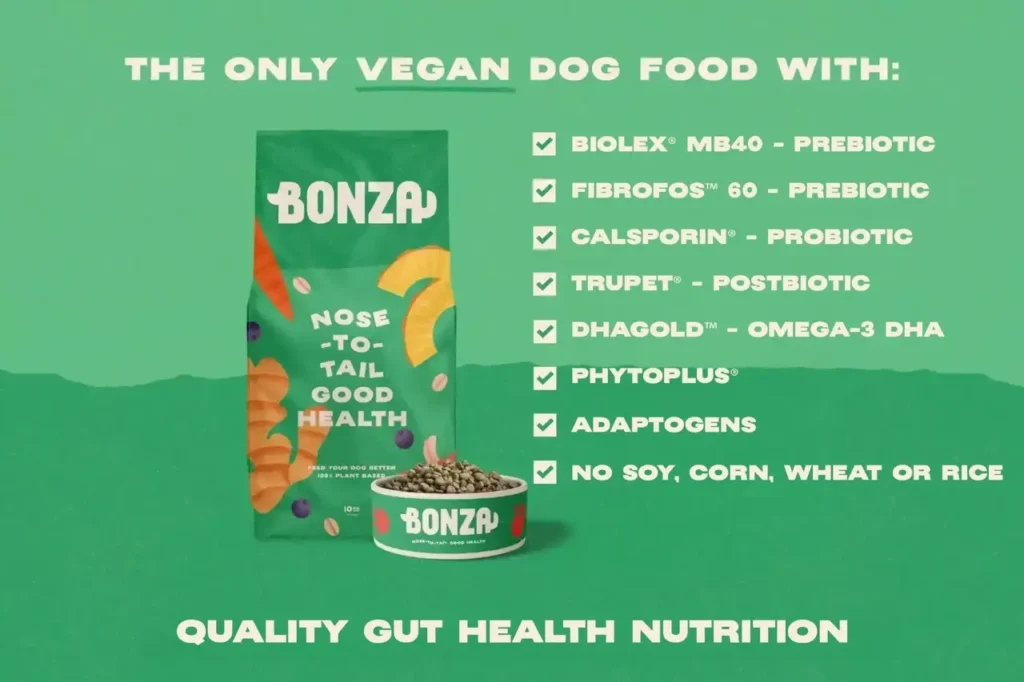
Across the fourteen foods compared, Bonza is the only one that delivers all three: chicory and yeast-derived prebiotics, the named probiotic Calsporin® (Bacillus velezensis DSM 15544) at 10⁹ colony-forming units, and the TruPet™ postbiotic. Every other food in the German set offers prebiotics alone, or nothing. For owners who understand that gut health underpins immunity, mood, skin and longevity, this gap is the most important finding in the comparison.⁸
Omega-3 DHA and the Omega 6 to 3 Ratio
Preformed DHA matters because dogs convert plant-based ALA into the usable long-chain omega-3 DHA very inefficiently, and the ratio of omega-6 to omega-3 matters because it governs the body’s inflammatory balance. A food can list “omega-3” and still deliver almost none in the form a dog can use.
Most plant oils, including flax, linseed and rapeseed, provide ALA, the short-chain omega-3. The problem is conversion: dogs turn only a small fraction of ALA into the DHA and EPA that support brain, eye, heart and joint health.⁹ A genuinely well-formulated plant-based food therefore includes a preformed source, almost always algal oil.⁴ In this comparison, Bonza explicitly declares DHA at 0.22%, sourced from DHAgold™ algae; Vegan4Dogs Greta names Schizochytrium limacinum as its DHA source; the three VEGDOG products include 0.1% algae each. Bosch lists “dried algae” generically without naming a species or quantifying DHA, so it is shown as partial in the matrix. Foods that rely on flax or linseed alone, including both Yarrah products, Benevo, V-Dog, AMI, V.E.G. Medio and V.E.G. Mini, are leaving their omega-3 provision largely to chance.
The omega 6 to 3 ratio is the second, often overlooked, half of the picture. Omega-6 is pro-inflammatory and omega-3 is anti-inflammatory, and the balance between them influences the risk of chronic inflammatory disease in dogs. Research suggests an ideal canine ratio between 1 to 1 and 4 to 1.¹⁰ ³ Only one food in this comparison declares enough data to verify it sits inside that range: Bonza at 1.87 to 1. Benevo declares its ratio at 3.13 to 1, also within the ideal range. At the other extreme, V-Dog Crunchy Chunks reaches 8.2 to 1, a potentially pro-inflammatory profile. The remaining ten foods do not declare omega levels at all, leaving buyers no way to verify what balance is actually in the bowl. The raw omega figures matter far less than the ratio between them, and a brand that does not declare both is withholding the more important number.
Carbohydrate Transparency: The NFE Test
You can calculate a dog food’s carbohydrate content yourself using the NFE test, but only if the brand declares every figure you need, and most do not. Nitrogen-free extract (NFE) is the standard estimate of carbohydrate, calculated as 100 minus protein, fat, fibre, ash and moisture levels.
The catch is that the calculation needs all five figures, and the one most often omitted is moisture. Of the fourteen foods compared, eight publish enough to calculate carbohydrate content. Two brands, both Yarrah products, go further and declare carbohydrate outright, which is genuinely to their credit. The other six make it impossible: by leaving out moisture, or in some cases additional figures, they prevent buyers from seeing one of the most frequently asked-about numbers in dog nutrition.
This is not a minor omission. Carbohydrate is often the largest component of a dry food by weight, and owners managing weight, diabetes or activity levels need it. Bonza calculates cleanly at 41.5% NFE, the lowest in the calculable set. VEGDOG Green Crunch and Farmer’s Crunch sit at the high end at 51.9% and 52.0%. VEGDOG Simply Crunch goes the extra step of declaring NFE outright at 50.0%, also creditable. The transparency of declaring the figures to make this calculation possible is itself a measure of how confident a brand is in its formulation. When a brand ‘hides’ the carbohydrate maths, ask why.
Clean Ingredients: Corn, Wheat, Soy and Rice
A “clean” vegan dog food avoids the four bulk ingredients most associated with canine allergens and environmental cost, corn, wheat, soya and rice, and only three of the fourteen foods compared meet that standard. These ingredients are cheap, which is precisely why budget foods lean on them.
Corn, wheat and soya are documented canine food allergens that can drive digestive and skin issues in sensitive dogs,¹¹ while rice and the monocrops carry significant environmental footprints. The cleanest foods replace them with potato, sweet potato, peas, lentils, beans, chickpeas and clean ancient grains or seeds. In this comparison, only Bonza (built on sweet potato, peas and the clean ancient grains oats and quinoa), VEGDOG Green Crunch (sweet potato, pea protein and lentils), and Bosch (potatoes 39%, peas 14%) are free of all four. At the other end, four foods lead on corn or corn gluten as their very first ingredient: V-Dog Crunchy Chunks, AMI, V.E.G. Medio and V.E.G. Mini. V-Dog Crunchy Chunks goes further still, declaring wheat, corn, soya, rice and pasta in a single recipe.
One important nuance deserves attention, because labels can mislead. “Wheat-free” does not mean “allergen-free”: Yarrah Wheat-Free, for example, removes wheat but contains 23% soybeans plus rice protein. And “grain-free” claims by brands using corn as a primary ingredient are themselves debatable, because corn is technically a cereal grain. Read the declaration, not the front of the bag.
Mineral Quality: Why Chelation Matters
Chelated minerals are bound to amino acids or organic compounds, which protects them from antagonists in the gut and means they are generally considered more bioavailable to your dog than the inorganic sulphates and oxides that cheaper foods use.¹⁴ In a market where every food is “complete and balanced” on paper, mineral form is one of the clearest signals of formulation quality.
A brand using copper sulfate, zinc oxide and iron sulfate is meeting minimum requirements at minimum cost. A brand using amino-acid chelates of all three has invested in delivery, because chelated minerals are absorbed more efficiently in the small intestine, so less unabsorbed mineral reaches the colon, where inorganic sources have been associated with increases in potentially dysbiotic bacteria in dogs.¹²
The difference is not merely theoretical: it shows in stool quality, in coat condition (well-absorbed zinc alongside essential fatty acids has been shown to improve coat gloss and reduce skin moisture loss in healthy dogs),¹³ and, over time, in how efficiently a dog uses the minerals it is fed.
In this comparison, only two foods declare full chelated mineral profiles: Bonza (Fe, Cu and Zn amino-acid chelates with organic selenium yeast) and Bosch (Cu, Zn and Fe amino-acid chelates with organic selenium yeast). The two VegDog Crunch variants and Greta declare partial chelation, mixing one or two chelated forms with sulphates and oxides. V-Dog Crunchy Chunks and Benevo declare fully inorganic mineral packages of sulphates and oxides. The remaining foods either declare partial chelation or omit mineral forms from their labels entirely. On mineral quality alone, Bonza and Bosch are the two foods in the German market that have made the investment.
Processing: Why Cooking Temperature Matters
Cooking temperature matters because heat degrades the heat-sensitive nutrients, probiotics and fats that make a premium food premium, and most dry foods are processed at temperatures high enough to do exactly that. Around 95% of dry dog food is made by high-temperature extrusion, typically between 110°C and 150°C.
High heat affects non-heat-stable vitamins, particularly the B group and vitamins A, C and E, reduces the bioavailability of some minerals, degrades heat-sensitive omega-3 fatty acids, and damages live probiotics. It also drives the Maillard reaction, the browning process that produces advanced glycation end products (AGEs), compounds linked to inflammatory disease.⁵ The more gently a food is cooked, the more of its formulated nutrition survives to reach your dog.
Only one food in the German set declares its processing method, which is itself telling. Bonza uses cold extrusion at below 70°C, by some distance the lowest declared temperature in the comparison. Every other brand leaves the question unanswered. For a food whose value rests on functional ingredients, the temperature those ingredients are exposed to is not a detail, it is the difference between a formulation on paper and a formulation in the bowl.
The Full German Vegan Dog Food Comparison
The table below summarises how every German-market vegan dry dog food compares on the markers that matter most. It is drawn entirely from each brand’s published data; where a brand does not declare an attribute, that is shown as “not stated”, which is distinct from a confirmed absence. For the complete interactive comparison across all 28 attributes, see the full matrix.
The pattern is clear. The cheapest foods, Vutter and V-Dog, win decisively on price per kilogram but diverge sharply on what else they deliver: Vutter is a genuinely credible budget option with chicory inulin prebiotic, ten declared botanicals, taurine and methionine fortification, while V-Dog Crunchy Chunks leads on wheat, corn, soya and rice with fully inorganic minerals. Bosch and VEGDOG Green Crunch share Bonza’s clean ingredient credentials but lack the functional depth, with Bosch matching on mineral quality but not on biotics, DHA or adaptogens.
Bonza is the only food combining clean ancient grains, the complete biotics triad, quantified DHA, joint support, adaptogens, full chelated minerals and cold extrusion in one recipe. Bosch is the strongest “clean alternative” in the market for owners who want corn-and-soya-free at a lower price point but accept fewer functional additions. Beyond those two, the field separates by what each food chooses to leave out.
One declaration in the set is worth a brief, fair flag. V.E.G. Medio publishes a Vitamin D3 level of 110 IU/kg, roughly a tenth of what its peers declare (most sit between 1,200 and 2,250 IU/kg) and below the FEDIAF minimum of 552 IU/kg for adult dogs. The same brand’s Mini variant declares 1,500 IU/kg, and across every other vitamin and mineral the Mini runs only about 1.4 times richer than the Medio, so a Medio D3 of around 1,100 IU/kg would fit the pattern. On that basis the 110 figure is most likely a published-data error rather than the true formulation. It is, however, the figure the manufacturer currently states on its official product specification, so a buyer would be right to ask the brand to confirm it before purchase, particularly for growing dogs or those at risk of bone or immune issues.
Customer Reviews Across the German Vegan Community
Customer reviews tell you something different from formulation: how real owners experience a food in practice. The German vegan retail community has built up review profiles on most of these brands across several platforms, and the scores are uniformly high. Read them as a validation signal rather than a ranking, because every food in this comparison sits between 4.74 and 5.0 out of 5.
The platforms vary, which is itself worth noting. Bonza uses Feefo, an invitation-only platform that verifies buyers before they can review. The three VEGDOG products are reviewed via Reviews.io on the vegdog.de site. Vutter uses Judge.me with 81 reviews recorded. Vegan4Dogs Greta carries reviews on its own vegan4dogs.com site. Most other brands, including both Yarrahs, V-Dog Crunchy Chunks, Benevo, AMI and V.E.G. Medio, are scored on independent German vegan retailers bio-tierkost.de and veganapf.de. Bosch’s score sits on Trusted Shops via the German retailer that supplied the data, with only 6 reviews to date.
Two things to know when reading these scores. First, Feefo and Trusted Shops verify the buyer before the review; open platforms like Reviews.io and Judge.me do not, although both have anti-fraud systems. Second, AMI’s 4.96 average is calculated across two platforms (bio-tierkost.de at 4.92 and kokku-online.de at 5.0), and the kokku reviews are from 2015–2017, predating Trusted Shops verification standards. Treat all the scores as broadly positive rather than precise rankings, and let the formulation comparison do the differentiating work.
An Independent UK Benchmark for the Crossover Brands
Germany has no equivalent to an independent expert rating service for dog food, but the UK does, and several brands in this comparison are sold in both markets. The UK’s All About Dog Food rates foods from 0 to 100% on ingredient quality, nutritional additives and processing, applying one consistent expert rubric across every food it reviews. Among the plant-based foods it has assessed, only two earn a “Good” rating: Bonza at 69% and Herbie Wilde at 63%, with the remaining reviewed foods scoring in the “Average” band.
It is worth understanding how AADF approaches plant-based food before reading these scores. AADF takes the editorial view that dogs do best on diets high in meat, and says plainly that it finds it “hard to fully endorse plant-based foods for dogs at this stage.” Its per-food “at a glance” assessment also marks down any food containing less than 30% meat as “not high in meat”, a criterion every plant-based food fails by definition, however well it is formulated. Bonza is a useful illustration: on AADF’s own assessment it earns every other available marker, rated Natural, Hypoallergenic, Clearly Labelled and Certified Nutritionally Complete, and loses ground only on the meat criterion no plant-based food can ever meet. Seen in that light, its 69% rating, the highest of any plant-based food, reflects a structural headwind rather than favourable treatment, which makes it a meaningful marker of formulation quality.
This remains UK-specific context rather than a German ranking, since most German-native brands are not assessed by AADF, but for the crossover brands it offers a third-party reference point a German buyer cannot otherwise access. The full breakdown sits in our companion guide, Best Vegan Dog Food UK: Every Brand Compared by a Canine Nutritionist.
Why Bonza Leads the Comparison
Bonza leads this comparison because it is the only German-market vegan dog food that combines clean nutrition, the complete biotics triad, quantified functional support and gentle processing in a single recipe. It is not the cheapest food, and it does not claim to be. It is the most complete.
Where most plant-based foods stop at meeting baseline requirements, Bonza is built on a different philosophy. One Gut. Whole Dog. The gut, and the microbiome, is not just part of your dog’s health, it is the foundation of it, sitting at the centre of immunity, inflammation, mood and longevity.¹ ² That is why Bonza is the only food here to deliver all three elements of the biotics triad together: prebiotics to feed the microbiome, the named Calsporin® probiotic to populate it, and the TruPet™ postbiotic to reinforce the gut barrier. Around that core sits the 28-ingredient PhytoPlus® blend of herbs, botanicals and adaptogens, quantified algal DHA at 0.22%, glucosamine 300mg and MSM for joints, fully chelated minerals for absorption, and cold extrusion below 70°C to protect it all.
The supporting credentials reinforce the picture. Bonza is B Corp pending, a 1% for the Planet member and a Rainforest Trust partner, with a smart delivery model that calculates your dog’s exact daily portion rather than locking you into the rigid two-, three- or four-weekly subscription cycle every other brand here uses. The result is a food that does more for the dog and asks less of the owner. The case is not that Bonza is the cheapest bag on the shelf. It is that no other food in Germany puts as much into the bowl.
Shop Bonza Superfoods & Ancient Grains and give your dog the most complete plant-based nutrition available in Germany.
Frequently Asked Questions
The best vegan dog food Germany overall, judged on formulation rather than price, is Bonza Superfoods & Ancient Grains. It is the only German-market plant-based food to combine the complete biotics triad, quantified algal DHA, joint support, adaptogens, fully chelated minerals and cold extrusion below 70°C in a clean recipe. The best food for your individual dog, however, depends on your priorities: the cheapest credible option is Vutter, while Bosch is the strongest clean alternative for owners wanting corn-and-soya-free without the full Bonza functional package.
Yes, a properly formulated complete vegan dog food can meet all of a dog’s nutritional needs, and a growing body of research links well-formulated plant-based diets to positive health outcomes.¹ ² The key word is “properly formulated”. Dogs are omnivores and can thrive on plant-based nutrition provided the food is complete and balanced to FEDIAF standards and supplemented with the limiting nutrients, particularly methionine, taurine, L-carnitine and preformed DHA. Always choose a food that declares these inclusions, and consult your vet before changing your dog’s diet.
Only three foods in the German market avoid all four of these common allergens and bulk ingredients: Bonza (built on sweet potato, peas and the clean ancient grains oats and quinoa), VEGDOG Green Crunch (sweet potato, pea protein, lentils), and Bosch Vegan Adult (potatoes 39%, peas 14%). Every other plant-based food sold into Germany contains at least one of corn, wheat, soya or rice as a primary or significant ingredient.
Compare vegan dog food brands on price per kilogram rather than per bag, on declared ingredient quality, on functional inclusions such as the biotics triad and DHA, and on transparency. Normalise the price because pack sizes range from 1.5kg to 15kg. Check whether the food declares its ingredient percentages, full analytical constituents including moisture, mineral forms, and Vitamin D3 levels. A brand that gives you the information to verify its claims is usually a brand confident in its formulation.
Yes, complete vegan dog foods are formulated to meet or exceed FEDIAF protein requirements, and many match or beat meat-based foods on crude protein. In this comparison, declared protein ranges from 20% to 27%. What matters as much as the quantity is the amino-acid completeness: well-formulated plant-based foods supplement methionine and taurine, the limiting amino acids, to ensure the protein is biologically complete. Check that your chosen food declares these additions.
Conclusion
The best vegan dog food in Germany is not the cheapest bag, nor the one with the highest protein figure on the front, nor the one with the most five-star reviews. It is the food that delivers the most complete, functional nutrition into your dog’s bowl every day, and the only way to identify it is to compare brands on what they actually contain rather than on how they market themselves.
When you do that, the field separates clearly. The budget options compete on price with very different formulations behind the headline number: Vutter delivers a credible if soy-containing recipe with prebiotic, botanicals and amino-acid fortification, while V-Dog Crunchy Chunks leads on wheat, corn, soya and rice with inorganic minerals. Bosch and VEGDOG Green Crunch share Bonza’s clean ingredient credentials but lack the functional depth. And one food stands apart: Bonza is the only German-market plant-based food to combine clean ancient grains, the complete biotics triad, quantified DHA, joint support, adaptogens and fully chelated minerals in a single gently-processed recipe. This is what One Gut. Whole Dog. means in practice, a food built from the gut outward to support the whole dog, for the whole of their life.
Whichever food you choose, choose it on the evidence, not the marketing. Your dog cannot read the label. You can.
Related Reading
- Best Gut Health Supplement for Dogs
- Prebiotics, Probiotics and Postbiotics: The Biotics Triad Explained
- The Dog Gut Microbiome: Vital Key to Dog Health
- Cold Extrusion Dog Food: Why Processing Temperature Matters
- DHA: The Healthiest Omega-3 for Dogs
References
- Knight A, Huang E, Rai N, Brown H. Vegan versus meat-based dog food: Guardian-reported indicators of health. PLoS One. 2022;17(4):e0265662. doi: 10.1371/journal.pone.0265662. PMID: 35417464. PMC: PMC9007375.
- Domínguez-Oliva A, Mota-Rojas D, Semendric I, Whittaker AL. The impact of vegan diets on indicators of health in dogs and cats: a systematic review. Vet Sci. 2023;10(1):52. doi: 10.3390/vetsci10010052. PMID: 36669053. PMC: PMC9860667.
- Burron S, Richards T, Krebs G, Trevizan L, Rankovic A, Hartwig S, Pearson W, Ma DWL, Shoveller AK. The balance of n-6 and n-3 fatty acids in canine, feline, and equine nutrition: exploring sources and the significance of alpha-linolenic acid. J Anim Sci. 2024;102:skae143. doi: 10.1093/jas/skae143. PMID: 38776363. PMC: PMC11161904.
- Bauer JE. Therapeutic use of fish oils in companion animals. J Am Vet Med Assoc. 2011;239(11):1441-1451. doi: 10.2460/javma.239.11.1441. PMID: 22087720.
- van Rooijen C, Bosch G, van der Poel AF, Wierenga PA, Alexander L, Hendriks WH. The Maillard reaction and pet food processing: effects on nutritive value and pet health. Nutr Res Rev. 2013;26(2):130-148. doi: 10.1017/S0954422413000103. PMID: 23916186.
- Pinna C, Biagi G. The utilisation of prebiotics and synbiotics in dogs. Ital J Anim Sci. 2014;13(1):3107:169-178. doi: 10.4081/ijas.2014.3107.
- Schmitz S, Suchodolski J. Understanding the canine intestinal microbiota and its modification by pro-, pre- and synbiotics: what is the evidence? Vet Med Sci. 2016;2(2):71-94. doi: 10.1002/vms3.17. PMID: 29067182. PMC: PMC5645859.
- Wernimont SM, Radosevich J, Jackson MI, Ephraim E, Badri DV, MacLeay JM, Jewell DE, Suchodolski JS. The effects of nutrition on the gastrointestinal microbiome of cats and dogs: impact on health and disease. Front Microbiol. 2020;11:1266. doi: 10.3389/fmicb.2020.01266. PMID: 32670224. PMC: PMC7329990.
- Heinemann KM, Waldron MK, Bigley KE, Lees GE, Bauer JE. Long-chain (n-3) polyunsaturated fatty acids are more efficient than alpha-linolenic acid in improving electroretinogram responses of puppies exposed during gestation, lactation, and weaning. J Nutr. 2005;135(8):1960-1966. doi: 10.1093/jn/135.8.1960. PMID: 16046723.
- Hall JA, Tooley KA, Gradin JL, Jewell DE, Wander RC. Effects of dietary n-6 and n-3 fatty acids and vitamin E on the immune response of healthy geriatric dogs. Am J Vet Res. 2003;64(6):762-772. doi: 10.2460/ajvr.2003.64.762. PMID: 12828263.
- Mueller RS, Olivry T, Prélaud P. Critically appraised topic on adverse food reactions of companion animals (2): common food allergen sources in dogs and cats. BMC Vet Res. 2016;12:9. doi: 10.1186/s12917-016-0633-8. PMID: 26753610. PMC: PMC4710035.
- Pereira AM, Maia MRG, Pinna C, Biagi G, Matos E, Segundo MA, Fonseca AJM, Cabrita ARJ. Effects of zinc source and enzyme addition on the fecal microbiota of dogs. Front Microbiol. 2021;12:688392. doi: 10.3389/fmicb.2021.688392. PMID: 34721312. PMC: PMC8549731.
- Marsh KA, Ruedisueli FL, Coe SL, Watson TGD. Effects of zinc and linoleic acid supplementation on the skin and coat quality of dogs receiving a complete and balanced diet. Vet Dermatol. 2000;11(4):277-284. doi: 10.1046/j.1365-3164.2000.00202.x.
- Pereira AM, Maia MRG, Fonseca AJM, Cabrita ARJ. Zinc in dog nutrition, health and disease: a review. Animals (Basel). 2021;11(4):978. doi: 10.3390/ani11040978. PMID: 33915721. PMC: PMC8066201.
Editorial Information
| Field | Detail |
|---|---|
| Published | 29 May 2026 |
| Last Updated | 29 May 2026 (first publication, clinical comparison standard; 14 foods, verified point-of-purchase German market data) |
| Reviewed by | Veterinary Advisory Board |
| Next Review | November 2026 |
| Author | Glendon Lloyd, Dip. Canine Nutrition (Dist.), Dip. Dog Nutrigenomics (Dist.), Founder, Bonza |
| Disclaimer | This article is for informational purposes only and does not constitute veterinary advice. Always consult a qualified veterinarian before making changes to your dog’s diet or supplement regimen. |